Showing posts with label Sea of Cortez. Show all posts

January 7, 2011

Isla Isabela

yes, mum, their feet really are blue
 I’m a terrible one for developing expectations of a place. I can’t say I ever end up really disappointed—but it’s just I have a really vivid imagination, so very few things live up to my own mental hype.
landing our dingy in the fish camp
 Isla Isabela looked like it might be one of these places. The guide books call the National Wildlife Preserve Mexico’s version of the Galapagos. And everyone we’ve spoken to has really loved it. We, however, have sailed by twice--both times unable to stop—either because of the weather or the hour (it’s not an anchorage to enter at night or in bad weather.) But this time we timed our arrival perfectly, we were early enough to hike the island and then have dinner before continuing south.
look for the little white-headed chick under the mama
 Isabela looks like a barren rock on approach. A barren rock that’s lousy with birds… In this respect it doesn’t seem much different than most of the islands we’ve visited this year. But once we were ashore we saw it was unique. I have never seen (or smelled) so many Frigate birds. They filled the trees, filled the sky and walked around on the ground beside us.

Trails crisscross the island and we headed through the jungle to the old volcanic crater (the source of the fresh water that supports the huge population) then around the crater lake and out to the bluffs.

Along the way we were treated to the sight of baby frigates peering out from their nests at us as well as the male frigates in full courting mode.
 Out at the bluffs we encountered the blue footed boobies. We understood there were some chicks around—but only saw the nesting birds and the courting males. Perhaps the fact the frigates were dive bombing the nesting birds was keeping the chicks in hiding.

We got a bit lost on our return hike and came across one of the many teams of researchers that have visited the island since Jacque Cousteau first made it famous—as we spoke briefly to them (and were set back on the trail) I wished we had longer to ask questions and really learn about this wondrous island.

A frigate going after a booby
 There is a wildness to Isabela that reminds us of all that is good in the world. And as we made our way back to the boat Maia spoke for all of us, “I’m so grateful we came here.”

December 10, 2010

Goodbye Guaymas--for real this time

Thursday
We're headed south. The wind is about 10-12 knots from our stern quarter and we're sailing in lumpy seas. The wind's dying though. It clocked around from ahead and as it did our speed dropped to 6 knots, it feels a bit like we're wallowing toward La Paz. And wallowing makes me queasy. Maybe it's simply sailing for the first time in six weeks that makes me queasy. Or maybe it's the fact we stayed up too late and drank too much with the new friends that we hope someday will be old friends that makes the start of this passage feel less than lovely...
Evan, Maia and Charlie are napping. In an hour or so we'll eat dinner and watch the sunset. Then the long night will start. There won't be much moon--but the stars will be bright. La Paz is still two days away--maybe by the time we arrive my sea legs will be back.
But for now I type, stare at the horizon and think, type some more and imagine flat seas, or a smooth stomach.

Friday
Despite the forecast for light and variable winds dropping to calm, the wind clocked to our stern and built to 12 knots or so by this morning. So we've been sailing since we left--averaging 6.2 knots--even with a few middle of the night hours of 3's thrown in there. Our original plan had been to explore our way south to La Paz--stopping in at a few anchorages we missed. But Evan has work waiting for him in La Paz--and with the slow internet connections (aka difficult work connections) of the South Pacific in our near future, we're both trying to squeeze as many work gigs as we can out of the next few months. We enjoy cruising more when the coffers are full...
The trade off for not stopping is we are enjoying what has become perfect sailing. The Sea isn't known for steady winds or smooth seas--and while the seas certainly aren't long even swells--the simple fact the wind and waves are both coming from the same direction is a huge treat.
At our current speed we'll hit La Paz sometime in the middle of the night. So we may pull in to one of the wide open anchorages just outside the harbour and wait for daylight. Maia has already begun planning our first dinner ashore--she points out this is the first time she's returned to a harbour after a long absence and she's beginning to get excited about seeing places she likes and doing the things she's missed.
We're still going to miss all the people who won't be there with us this Christmas--but her confidence in the fun we'll have is making me excited too.

----------
radio email processed by SailMail
for information see: http://www.sailmail.com

October 22, 2010

Cruiser with a (real) Cortez Pearl Pendant

Cortez Pearls
It’s hard for me to let go of a story. Our friend Monica on S/V Savannah commented on this. She said when I find something I’m curious about I research it until I have the answers. But when she finds something she’s curious about she says, ‘interesting,’ and then kicks back and relaxes.

I’m sure she’s exaggerating, but I do get a bit obsessive, which is how we found ourselves at Perlas del Mar de Cortez talking to one of the owners and founders, Douglas McLaurin about black pearls in the Sea of Cortez. You may recall the story about the pearls Meri and I found in Santa Rosalia. Well, we dispatched with that mystery rather easily: A quick look under a long wave ultraviolet light proved they weren’t Cortez Pearls (Sea of Cortez pearls contain porphyrins which make them glow), a few other simple checks and it was confirmed--we own freshwater pearls from China, dyed using dubious methods and sold around the world…

The good news is McLaurin broke this bad news in the middle of a showroom that contains some of the most beautiful gems I’ve ever seen. And as he told us story of how the pearl showroom came to be, it was almost hard to concentrate on his words (I think I'm part magpie...).

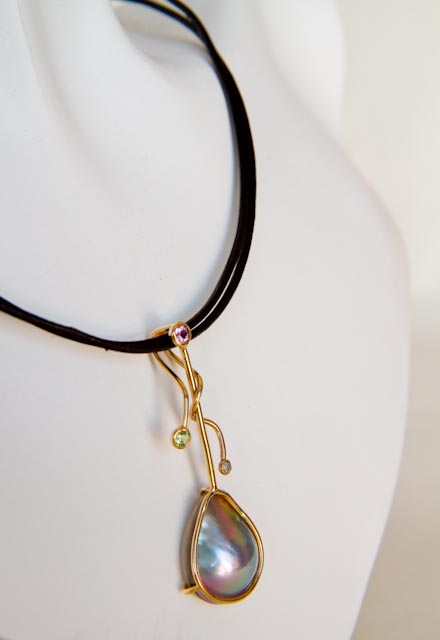
a mabe pearl in a designer setting (they also have pearls in simple silver settings for people who don't have designer budgets...)
The story of Cortez Pearls almost sounds like a fairytale. In the 1990's Mclaurin and his partners Enrique Arizmendi and Manuel Nava Romo were graduate aquaculture students at Tec de Monterrey. They were instructed to create an aquaculture business that could be developed in a real life setting. Because their business would be on paper only—they decided to dream big: They would revive the mythical Sea of Cortez Pearl industry using a near-extinct native species and modern culturing methods.
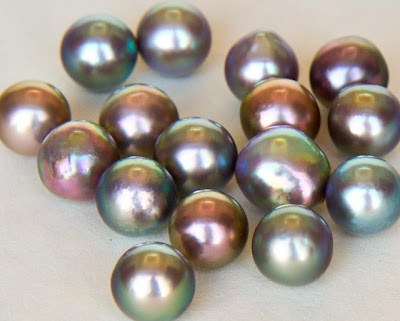
A gem-quality cultivated pearl
The three students received a C- on their paper. They were told the species they wanted to grow, the Pteria Sterna had never been successfully cultivated, saltwater cultivation had never occurred successfully in North America and their business would fail.

The students decided that the only way they could respond to their poor grade was to prove their teachers wrong. With no resources and only a limited idea of what they were doing they began a research project—which to everyone’s shock yielded pearls.

The three continued to farm: learning by trial and error, one year loosing 90% of the farm to a hurricane.
Cortez Pearls employs 18 people, including several Yaqui--the original pearlers
The thing that struck me most (when I could take my eyes of the pearls) is the commitment the three men have to creating an ethical business--the pearls are the first in the world to be fair trade certified and the farm has helped reseed the once abundant bay with wild oysters.

The truth in this fairytale is the pearls themselves: During harvest in July and August the farmers open the oysters which have been growing for four years. Just a fraction contain pearls. Of that number only a fraction are gem quality (the rest are returned to the sea). And of those gems, once in a while one comes along that makes Mclaurin (who by now has seen more pearls than he can count) forget every other pearl he’s ever seen.

**I don’t normally make a pitch for a place this way, but this is a truly unique farm run by some very special people. If you have an attachment to the Sea and want to support what these guys are doing now is the time to buy a keepsake. Between the drug war cutting off tourists and the economic downturn, they are hurting. http://www.perlasshop.com/

October 20, 2010

Nacapule Canyon Hike

In the language of the Yaqui people nacapule (pronounced knock-ah-poo-lay) means earlobe. It’s also the name given to a rare fig tree that has generous knees like a Cypress tree and to a canyon that I read about in a tourist brochure.

Places that we read about in tourist brochures are often out of reach for us—for two reasons: they are either too far to get to by foot, or bus, from our boat, or they cost too much for our non-tourist budget. Then there is the fact that wild places that are populated by tourists sometimes have the magic scrubbed out of them—they’ve been made so accessible that the essence that made them captivating is gone.

But because I’m doing a story on San Carlos and need to see the things that tourists see I pay attention to the tourist brochure. And this morning we found ourselves following roads north out of San Carlos. Our guides Fernando and Miguel drive us through the suburbs, then across an arroyo and through familiar desert. Ahead of us is the Sierra Aguaje Mountain range, a string of rugged volcanic formations, where black, red, and rust-hued strata fold over each other in graceful tucks and pleats.

As we grow closer to the mountains our destination becomes clear: a deep ocher-coloured cleft carved into the cliffs. We park and Fernando leads us along the trail to the canyon, pointing out ironwood and jasmine, chichinoco squirrels and swallowtail butterflies. Miguel explains how rare and fragile the sub-tropical ecosystem of the canyon is as he leads us deeper into the desert oasis.

Along the way we pass a bit of graffiti and a few burned palms and Miguel explains that locals are only beginning to have reverence for the canyon. He explains that for the Yaqui people the canyon was sacred—that between the year-round springs-for water, plentiful wildlife-for food, large trees and obsidian rock-for tools, the ancient people found all they needed here.

We continue to make our way up the canyon, following a trickle which gives way to deep tea-coloured pools filled with rare frogs and swimming snakes. The air (which can be unbearably humid in the summer) is comfortable and cool. We scramble over blood-red rocks, through palmetto thickets and up a small cliff—until we find ourselves in the heart of the canyon where the graceful Nacapule fig grows, its bark wrinkled like elephant's but silky to the touch.

It’s hard not to fall in love with a place like this—a place so mystically beautiful I want to keep going long after the trail turns more rugged than we’re comfortable with. So we sit for a while and soak it all in. Then we head back down the trail, leaving nothing behind and collecting the small bits of garbage along the way so the next hikers might understand that this a cared-for canyon, a sacred place that can provide us with everything we truly need to thrive.

October 14, 2010

Among Whales

This one's beside us and several more are straight ahead, and a few more are on our other side...


I think there are five whales in this shot--more than you really want in front of you.
The moment when I suggested that Maia should back away from the edge of the boat
They were hunted to near extinction and even today no one's certain just how many sperm whales are out there. They used to be known to travel in pods of up to 50 whales, with still other groups within their vocalization distancce (about 10km). But after they were hunted and their numbers diminished they were seldom seen in groups larger than twelve.

We really don't know how may we travelled through--at one point I counted 26, and that was after sailing through three distinct pods over four hours. But what we learned is sperm whales won't move out of our way. They are pretty unconcerned about where we are going and what we are doing. They seem to exist somewhere else. Maybe in an older version of the world where they ruled the seas.

We tacked through them though and did our best to keep clear. The punishment for getting too close was a strong wiff of rank whale breath. But the reward, ah, the reward...

October 3, 2010

An Octopus's Garden

"I can see the bottom," Evan told us as we pulled into Los Rocas and anchored in 30 feet. The clear water, and the fact the air temperature was already 33 C, was enough to make us jump in and snorkel over to the nearby reef. But as we neared the rocky outcropping a Mexican panga arrived. A diver with a Hookah rig went over the side. We swam closer to the reef and ran into another snorkelling cruiser, she'd learned from the diver they were after octopus.
Los Rocas is in a park. And as far as we understand fishing here, and for that matter anywhere with a Hookah rig, is not legal. The octopus, which the other cruiser told us were present, but not abundant, didn't have a chance.
We were suddenly confronted by the quandary that all cruisers in the Sea are being faced with. There are some cruisers and a few organizations that see us as the potential police of the Sea. Mexico has decent conservation laws, but there is no funding to enforce them. The argument is that because cruisers are in the region in high numbers, we can confront and educate fishermen about their own laws. Or we can call authorities on the radio (if there are any in the area, which is rare) and turn in the offenders.

In theory this makes sense. But in practice there are problems. Sailors and fishermen in the Sea used to have a pretty good relationship. Even the cruisers who were here last year talked about how easy it was to trade with fishermen and how the fishermen never hesitated to come to cruisers if they needed help. This year the trades aren't happening and a slight wariness is replacing friendliness.
The reality is we need to learn to conserve. Simply sailing through this Sea-which is one of the most abundant nursery waters in the world--is ample proof we are in real trouble. The analogy is we are clear-cutting the ocean and not replanting more than a few token trees. But conservation is proving to be almost impossible to enforce: As evironmental edicts imposed on poor, or hungry people fail again, and again. And if cruisers start turning in all the fishermen we see breaking laws (which frankly, includes ourselves) we'll not only fail to make progress, we'll stop being welcomed.
Conservation is always most effective when it's a grassroots effort. When local fishermen and tourism providers understand that the only way their livelihood is going to survive is by protecting the stocks, they tend to make strides. Government can help, but not simply with laws, we need to demand funding for education and alternatives. People need to be paid not to over fish. And consumers need to demand fish that has been carefully caught. Or, to put it another way, we have to learn to pay for the real cost of fish, which includes the cost of replacement and protection.
That clam, oyster, or lovely Mahi-Mahi steak needs to be valuable enough (and expensive enough) that the fishermen who caught it can earn a living, while taking the time needed to avoid by-catch and actively protect the place it came from.

"They are getting closer to the octopus's lair," the other cruiser told us as we swam. "Maybe if we swim over there and stay right in front of it, the diver will go away."
We swam toward it. But the diver didn't slow his methodical hunt. So many things went through my mind as we hovered over that octopus's barely hidden lair: My long ago memory of linking arms in front of big old growth trees, trying to stop loggers; Late night discussions about how finding a way to get people to care about their environment; The more recent memory of walking down Dead Beach with Maia.
I looked at my daughter. Busy somersaulting underwater; she was oblivious to the octopus's plight. Glancing back at the approaching diver, who was likely earning a wage that I couldn't fathom living on, we slowly swam her away from that beautiful little lair.
----------
radio email processed by SailMail
for information see: http://www.sailmail.com

September 13, 2010

Whale Sharks-3rd time lucky

You could say we've been tracking the truck-sized fish-albeit badly. First we arrived in La Paz a day after they began their northern migration. Then we heard they were in Escondido, but also missed them there. When we arrived in BLA I thought we might be in for the same results. Everyone we asked said they had been practically tripping over the mammoth sharks right up until the day before we arrived.
whale shark fin on the surface
 Locating a school of fish, where each is the size of our boat, is trickier than you might think. But I asked a lot of questions and learned we needed to be on the lookout for a fin and tail on the surface. I also discovered that the whale sharks tend to cruise in schools through the shallow water in the south bay-from the village of BLA down toward La Mona, a distance of five miles. Narrowing my search down to a 5-mile swath seemed simple, after all, we'd already come 350 miles in our search for them.
This morning, before I even had my morning coffee, I was out on deck with the binoculars pressed to my eyes. Almost immediately I spotted a fin not far from the boat. I watched as it drifted lazily, thinking it was moving at the right speed, but seemed a bit small. Maybe it was a sea lion with a deformed flipper… Despite my doubt I rounded Evan and Maia up. We grabbed our snorkeling gear and piled into the dinghy. I directed Evan to where I had seen the fin--and saw nothing. We motored around for another 10 minutes then called it quits. Finding the world's biggest fish was going to be trickier than I hoped.
there is something wonderful about the fact that the world's largest shark is not only gentle, but has yellow polka dots...
 I spent the morning in a dejected state. Occasionally I checked the water but it wasn't until I recalled that in La Paz Mike and Hyo from Io had followed a tour boat out to the sharks that I had hope. This isn't a tourist Mecca but I scanned the south bay for pangas and actually found one sitting in a quiet cove. We loaded back into the dinghy and sped toward it.
Sharks!

It was clear as soon as we arrived in the little cove we'd found the sharks. I saw the fins on the surface (exactly like the one I'd seen earlier in the morning, and far smaller than I would have expected.) Three or four of the huge filter feeders swam around us-first fins, then yellow spots and stripes suddenly appearing out of the murky green. Maia thought twice about jumping in after a particularly large shark cruised under the dinghy, dwarfing us, but she dove in soon after Evan did.
Evan encounters a little juvenile
 The whale sharks seemed unbothered by visitors and were potentially even curious about us. They'd circle around us, swimming closely enough for us to touch them (while I back paddled and emitted high-pitched squeals.) Their size and bulk wasn't intimidating though-they swam slowly and moved with gentle full body swishes. It was more the way they kept surprising us that made me squeak. After doing a circle or two the sharks would dive and disappear. But just when we gave up on seeing them again they'd reappear, swimming at us head on.
Having a huge shark (which despite its cheery polka dots, still looks like a shark) swim directly for you is, umm, invigorating. But the only real hazard is being hit by the massive tail. The sharks only reach a whopping 5 km/hour in speed but their big tail swings through a large powerful arc. We tried to keep our bodies between Maia and the shark-to keep her clear of the tail. But at one point a particularly intrusive shark separated us and Maia, in her need to be by my side, levitated over the shark's broad back to get to me.
The experience was a phenomenal one. We wished the water was clearer and that we brought our better camera-but that hour long swim is locked in our memories.
Check out the great pictures by Andy on the blog Savanah.
----------
radio email processed by SailMail
for information see: http://www.sailmail.com

September 8, 2010

San Francisquito

it's easy to ignore bad weather when this is the view...
Once you leave Santa Rosalia it's almost 80 miles to Cala San Francisquito, the next good anchorage. Making it either an overnight, or a very long day passage. The other detail that you need to factor in, is the further north into the Sea you get--the weirder the winds, the stronger the currents and the higher the tides. We pretty much ignored this detail, and when the boat hit 12 knots while sailing upwind in current riled seas that had 30 knots blowing across them, I started to wonder if a big heavy monohull might be the more comfortable way travel in conditions that changed seemingly every few minutes.
A few hours later, when we should have been sailing downwind at 6+ knots, but were crabbing across a channel at just under 3 knots, I found out from the folks on Hotspur that they had, had just as wet and uncomfortable a ride as we had. Strangely it made me happy to know none of us were terribly comfortable on the beautiful trip..
Today though—I've pretty much forgotten any discomfort that came with getting here. We're tucked into the calm little inner bay with Hotspur and two other boats. The air temp is a few degrees cooler than Rosalia and the water is clear and blue. On the night we arrived, which was Maia's birthday, there were fireworks on shore. We ate cake and drank Sangria while the sky lit up.
You could pass days in a place like this and lose track of the hours and then the weeks. This morning Meri and I set off on one of the dusty roads past the three or four buildings that make up the settlement and walked until we hit a long exposed beach with crashing surf. On the way back we passed a pile of oyster shells—and admired the mother of pearl interiors and wondered about the black pearls they may have contained. Later in the day Evan and I set off for a dive with Terry and Dawn from Manta and learned to recognize black coral and how to negotiate a strong current. Tomorrow I plan to hike along the ridge that borders the anchorage until I reach an old stone fence that had been a mystery to me until Dawn told me what it was for.
the stone fence looks close to the anchorage--but it took almost an hour of hot hiking to get to it
I think this cow didn't make it
 The fence is strange and out of place. Built painstakingly on the side of a steep hill it was once a cattle enclosure. In the early days of the settlement, before there were roads, they raised cattle around here. Boats would come for the cows, but they were too big to make it very far into the bay. So the farmers would drive the cattle along the ridge and down into the fenced pen, and from the stone pen they somehow were driven straight downhill another 30 or so feet and into the water—there the waiting boat would lift them by slings into its hold.

My guess is the cows didn't like it. But the old stone fence is still beautiful.
----------
radio email processed by SailMail
for information see: http://www.sailmail.com

September 1, 2010

The 8am Whale

This isn't Ocho, she arrives before coffee and I'm too slow with the camera. It's a minke whale in the St Lawrence that I saw in July. Ocho is about the same size.
The first time I heard the heavy puff I was barely awake. I was standing on deck taking in the rising sun, the calm water and the leaping mobulas. The puff, I thought, must be a sea lion breathing, or waves hitting the rocks. Then the puff came again.

The sound of a whale breathing is hard to mistake. To breathe a whale expels water and air from their blowhole(s) then inhales air into its lungs. On the surface they breathe every 2 minutes or so. A dive can take them underwater for anywhere up to an hour, depending on the species. My puff came at regular intervals: one every 1-2 minutes for three puffs, then a five minute break. Then it repeated itself.

It seems obvious, now, that I should have been looking for a whale. But when you’re anchored in a quiet cove you don’t expect one of the world’s largest mammals to pop in for a visit. But this is what Ocho did, every morning at about 8am she would swim past the anchored boats at Isla San Carlos. Sometimes Ocho would surface only three or four times and then disappear, while other times she’d do a few laps and keep us guessing as to where she’d surface next.

I started drinking my coffee out on deck, trying to get a good view of the whale. Unlike a grey whale or an orca, Ocho only surfaced briefly to breathe. Her dorsal is small and well back along her body. She isn’t very big. My guess initial guess, based on her size, was she’s a minke. But minkes often travel in pods and Ocho seemed to be on her own.
A full grown finback is a stunningly huge creature. They tend to keep to the same habits, which makes me think Ocho might be a young finback.

On our last morning out at Sweet Pea I decided to try for a better look. Before the first telltale puff I headed out in the kayak. Ocho showed up right on schedule, a few hundred meters away from me. This time when she came up and I saw where her small dorsal was placed on her long back, I decided she must be a juvenile finback (there’s a resident pod in the Sea of Cortez). I watched her surface and dive a few more times as she moved away from me, then continued my paddle, satisfied I knew what I was seeing.

An hour or so later I was swimming with the girls off our boat when the puff came again. It was louder this time and echoed off our hull. When we looked for Ocho we saw her surface nearby. The girls squealed in amazement and delight. But I just stared hard at her fin. I was undecided about her species again. “I wish I knew what she is,” I told Maia.
“I know,” Maia told me, “She’s magic.”

August 31, 2010

Cruiser With a (Cortez??) Pearl Earring


The glass case was dusty, its contents looked half forgotten, but the shop keeper pulled out several of the pearl earrings for Meri and I to inspect. The pearls were black and iridescent, and based on the shape and texture they seemed real enough. The jewellery, the shop keeper told us, was made by prisoners in the Santa Rosalia jail. The pearls, he said, came from the Sea of Cortez.

The pearl is part of the Sea’s almost forgotten history. From 1500 to 1800 Mexico was the world's main source of black pearls. Catherine the Great and Marie Antoinette both sported jewels that came from the Sea of Cortez. For almost 300 years ships came from Spain, England, Holland and Russia to trade for the jewels and in response native divers dove for the oysters, killing over a hundred of the creatures just to obtain 3-4 quality pearls.

‘Pearl fever’ outstripped the ability of the “Sea of Pearls” to naturally produce. And as supply dwindled, diving for pearls became progressively more dangerous. The divers forced themselves to go further and deeper, and they returned with fewer and fewer rewards. By 1800, or so, the industry had all but collapsed.

In 1893, the world’s first commercial cultivated pearl oyster farm was started on Isla Espiritu Santo, near La Paz. At its peak, the farm grew 10-million black-lipped pearl oysters and employed over a thousand workers. Compania Criadora de Concha y Perla was mainly in the business of producing mother of pearl—but a surprising by-product was discovered when it turned out that over 12% of the oysters also produced good-quality black pearls.

When the Mexican revolution came, the pearl farm was destroyed. In the decades that followed there were a few poorly executed efforts to rekindle the pearl industry. But for the most part Cortez pearls were forgotten. The oyster beds became extinct and the fabled black pearls of Tahiti (which are not as luminous or colourful as Cortez pearls) took their place in the market.

Knowing this history made me question what I was seeing in that half-empty Santa Rosalia shop that also sold discount flip fops, faded pool toys, and clothes pins. The pearls were imperfect, their shapes irregular and the colours ranged from grey-green to charcoal—but all had the same kind of glowing opalescence that once entranced royalty.

After checking online for pictures of the Cortez pearl, it seemed as though Meri and I had stumbled across something a bit mysterious. We questioned the shop keeper carefully—but all he knew, or could tell us, was that the pearls were local. Who harvested them and whether they were natural or cultivated, we never learned.

A few fishermen still find natural pearls, though not in the numbers they once did. Rumour is they guard their secret oyster beds and the best pearls quickly find their way to dealers of rare gems. Cultivated pearls are grown in two locations; there is a very small government facility near La Paz—with a production that’s said to be fairly poor--and there’s a larger commercial facility, Perlas del Mar de Cortez, near Guaymas (a ferry ride from Santa Rosalia). Perlas del Mar has been producing pearls commercially from rainbow-lipped Pteria sterna oysters for about 10 years. The farm only produces between 4000-5000 pearls a year, and most of the gems go to dealers and collectors.

The Santa Rosalia pearls though, they remain a mystery. They cost a fraction of the cultivated Perlas del Mar pearls and are not nearly as perfect. It also seems unlikely that they are natural pearls, there are too many of them. So we have no idea where they are actually coming from. 

**The update is we were taken. The pearls are your standard issue Chinese freshwater pearl which are dyed using a variety of nasty techniques to look black.

August 1, 2010

Calm


We're making the 45 mile passage from San Jaunico to Bahia Conception. Our plan was to start early and then catch the afternoon breeze and arrive mid-afternoon. But now, at 3pm, with miles still to go, the sea is as calm as I ever seen it. There is barely even motion on its oily surface. The air is hot, humid, and still. The only real movement we see is from living things and growing thunderheads.

The thunderheads seem close. But I've already discovered that a flat sea distorts distances. We watched an island (which seemed close enough to land on) never grow nearer-just slightly larger. I know from the geography of the place that the thunderheads are really on the far shore.
Dolphins leaping

When it's this flat, and this hot, there is nothing to do but stare into the ocean. It's better than TV, Maia says. You need to know she has never had cable... But we do see things in the flat water we’d never see when there are waves. The hump of a turtle’s back is clearly silhouetted, as is his head when he raises it to look around, and his back flippers, which show after he sees us and begins his dive.
Manta Rays from above

Under the surface we can see schools (flocks?) of manta rays—gliding along as though in flight. When they leap free of the ocean it makes me wonder if they are aching to be birds, if soaring away will be their next evolutionary step.

I think on a day this quiet that the sea creatures find us interesting too. How else would you explain the great numbers of dolphins that have visited and the rays that glide right up to the boat? An animal we could do with less though are the boobie birds. Three times one has dove for our fishing lures, almost becoming the only thing we've caught today... What amazes me is the same bird will dive on the same lure more than once. We've heard stories from other boaters who have caught a boobie, managed to free it (with no small effort and bloodshed on the sailor's part) only to have the liberated bird dive for the lure a second time.
We watched the boobies circle above our lure and dive, then do it again...
I've come to the conclusion their behaviour is out of optimism rather than stupidity though. And I've been pondering the question for a while. It's too hot, and too still to do much else...

June 5, 2010

Leaving La Paz


 We left La Paz today. After stocking up with everything we thought we might need and finishing as many projects as we could before the heat makes them too difficult, we spent a final couple of days just enjoying the town and getting to know a few more people. Then we hauled up an anchor rode that was growing mussels, filled our fuel tanks and set out.

  The Dockwise boat, loaded up with vessels not making the 'bash' back up to Washington and BC. These boats are going home after months or years of cruising.

We’ve hit the point in the cruising season where those who are going elsewhere have gone, those who are heading home are on there way and those who are leaving their boats and heading to cooler climes are packing up. The heat is rising, hurricane season is beginning to seem more real, and our numbers are dwindling.
 The goo on our anchor chain tells us it's time to go

The good part is we’re almost done with goodbyes for the summer. Pretty much from here on out, the boats we hang out with will be the ones who are summering up in Camp Cortez.

I remember the last time we summered in the Sea as one of the most relaxing and magical periods in my adult life. So tonight as we watch the light change on the red desert rocks, and let the red wine seep in, it’s hard not to feel just a little excited.

The fact that a manta ray just came by to greet us only adds to the pleasure.