We're sailing through plastic stew. The first time this happened we thought we'd come across debris from a wreck. But hours later we understood: currents concentrate the garbage and the ocean's power renders it unrecognizable. People ask if I'm ever afraid out here. This scares me.
This e-mail was delivered via satellite phone using Iridium Mail & Web software. Please be kind and keep your replies short.
October 10, 2016
Garbage Soup
Passage to Cartagena day 3
Continued light winds and dolphins. When they breathe out their blowholes sometimes we see rainbows in the mist.
This e-mail was delivered via satellite phone using Iridium Mail & Web software. Please be kind and keep your replies short.
October 9, 2016
Passage to Cartagena
Mellow light wind spinnaker passage populated by pilot whales and spotted dolphins. It took seven years of watching dolphins with a kid for me to spot one pooping.
This e-mail was delivered via satellite phone using Iridium Mail & Web software. Please be kind and keep your replies short.
September 29, 2016
Waiting for Hurricane Matthew in Curacao
![]() |
| Lovely and well-protected Spanish Waters--there are several anchorage areas and marinas tucked around the big bay |
Then there’s the simple fact that historically Curacao doesn’t get hurricanes—but then we arrived and
suddenly one headed straight this way.
Much of our week has been spent tracking and discussing Matthew’s,
umm, track. As of this morning, it looks like we’re off the hook. Matthew has
ended up going well north of its initial path so rather than getting tropical
storm conditions all we really expect is a good deck wash.
We did opt to move the boat into a narrow channel that offers
better protection from the south and west. The official anchorages offer great
protection in the easterly trades but with a storm on the horizon, the port
officials opened up the entire bay to anchoring.
While we were waiting for the storm to decide what it was
going to do, we decided to dig into a few projects. Our auxiliary Tohatsu 6
Sailpro outboard has always been cranky—not running more than it runs. Evan
broke down and got it a new carburetor—which we assumed would do the trick, but
nada—so it’s off to the mechanic tomorrow.
We also have the material for new dinghy chaps. When we were
in South Africa
we had our old dinghy retubed for about $600. But the tubes are PVC, and they
won’t last well in the tropics. With a flat-calm anchorage at our disposal
we’re going to get sewing. We’ll also keep painting and varnishing.
![]() |
| Windsurfing lessons for gym class to keep Maia busy and beat the heat |
There’s also been time for fun, now that Maia is mostly
recovered from Zika. Yesterday we toured the city—visiting the forts; the
Curacao liqueur distillery at Landhuis Chobolobo (nothing like bright blue
liqueur for breakfast); and the impressive and sobering Kura Hulanda
Museum. The museum was
high on my list of places to visit. Two of my recent stories have required a
lot of research into the African Slave trade—and the Kura Hulanda museum, which traces
the history of many of Curacao’s residents,
has a sensitive and emotionally powerful display of artefacts from enslaved
Africans.
![]() |
| being able to touch these manacles made my blood run cold |
After exploring for a few hours we finally managed to get to
Marshe Blue for a local lunch (I drew the line at stewed goat head and curried
sea snake). Evan had goat (the body bits, not the head)—while Maia and I stuck
with the more familiar (and delicious) red snapper.
![]() |
| local lunch at Marshe Blue |

Each time we set off exploring we grow to like this place a
little more. Our initial impression was Punda was just a big outdoor shopping
mall with a gorgeous facade. But as we’ve spent time wandering the narrow
streets and popping into the historic buildings I find myself intrigued by the
people who decided to settle here. The buildings are all made from coral
stone—which because of their high salt content buildings require constant
replastering and repainting. But somehow—despite the challenge of maintaining
them (and finding a way to make a life in this desert environment) this is an
intriguing and thriving island.
![]() |
| boats from Colombia and Venezuela bring produce to the floating market |
![]() |
| hanging out on Galactic |
![]() |
This week we’ve also had a chance to get to know the Galactic family. If you don’t
follow their blog—give it a read. These folks are hardcore; crossing oceans
with toddlers, sending them to school in the Australs and then sailing to South Georgia... Alisa made the off hand comment that even after crossing the South Atlantic she wasn't in a mad rush to hit the grocery store because she's used to provisioning for seven months at a time and it had only been two! Compared to them, we’ve yet to take a
risk. Makes me think we ought to go around one more time, just to make it
trickier.
![]() |
| baby Ceilidh |
But while they may be going for twice in a lifetime—for now,
we’ll call once enough. We’ve left some beautiful things in our wake and this
week we learned about one of the most wonderful: our dear friend Lewa in Fiji had her
second son and honored us by naming him after us. We hope the name brings wee
Keffy Ceilidh joy.
September 23, 2016
Weighty matters
I thought I'd write a little essay on boat weights. There is a lot of misinformation I hear from my fellow sailors, so this is an attempt to educate. I'll try not to get too technical.
Do you know how much your boat weighs? Probably not. "Wait!" I hear you cry - "I asked the Travelift guy how much it weighed when we last hauled out". Unfortunately the scales on a Travelift are usually just a pressure gauge which is measuring the pressure in the hydraulic system that is lifting the boat. And there is a scale reading in pounds but it's just a scaled pressure value. And they are never calibrated on a regular basis.
They are notoriously inaccurate for a variety of reasons:
- the manufacturer probably sets them to read high to reduce the chance of overloading the lift
- there is friction in the pulleys/wire ropes etc. which can vary from lift to lift
- straps and shackles are changed and they weigh less or more
- sometimes a lift will use 2 straps, sometimes 4 or more on the same lift. Sometimes big heavy spreader bars will be used so that 4 straps can be used. The gauge doesn't know that.
Every time we haul out, I ask the operator the weight. It's never close to the same amount twice. I'm talking thousands of pounds difference here. At one haulout in Australia, we got about 2500 lbs heavier in the four days we were hauled out. I don't think the new antifouling paint was that heavy...
What's the best way to find out how much she weighs at a given time? Lift it with a crane that has a recently calibrated load cell or put it on a trailer and take it to a truck weigh station, knowing the weight of the empty trailer.
Displacement of a boat is simply how much she weighs. When a boat is floating in water, she will displace (push aside), an amount of water that weighs the same as the boat (see Archimedes for further details). The weight or displacement of a boat will vary depending on how much fuel, water, food, and bottles of wine she has aboard at any given time.
"Brochure Displacement" This number you will see printed in boat sales literature. It used to almost always be simply "Displacement XXX lbs". If you're going to quote one number for displacement of the boat, traditionally it was "1/2 load displacement". The naval architect would assume that fuel and water tanks were 1/2 full, some crew was aboard, some food, some gear, etc. It's an awfully fuzzy figure, because of the assumptions that about how much the food, gear, crew all weighed. They never assume that the boat is going long distance cruising with thousands of pounds of extra gear or food aboard. It's more of a "weekend displacement".
In reality sailboats are always heavier than brochure weights. Manufacturers want to keep weights down because a lighter boat is known to sail better than a heavier boat. Perhaps they don't lie as such, but they can be very optimistic in their numbers and justify it by saying they never weigh the finished boat. O.K. they lie. I would guesstimate that often sailboat brochure displacements were 20% lower than actual weights with minimal gear aboard.
Catamaran builders are even worse. Generally they would quote "Displacement" - but wouldn't tell you they were quoting Lightship Displacement. Lightship is N.A. talk for "Boat is empty of fuel, water, food, crew, and gear". So you get a nice low figure but it's not realistic for how much the boat weighs in service.
Recently the European Union decided that enough was enough, and cracked down. So now in CE marked boats you will see lightship displacement clearly indicated. I think they are supposed to actually weigh a few representative samples of vessels and not just guess at the weights.
A new Fountaine Pajot Lucia 40 catamaran has an "displacement unloaded" of 9800 kgs (21,560 lbs). She is actually 38' overall so that is a very heavy catamaran.
Compare that to a much earlier 1998 F-P Athena 38. Her displacement found in various reviews is between 11,000 and 12,230 lbs. Yes, catamarans have gotten much heavier in the past decades - but I bet that the Athena is probably a bit heavier than the brochure ever said.
The Lagoon 38 was a porker at 15,962 lbs. Empty.
The new Catana 42 Carbon (actually 41'). 8900 kg (19,580 lbs).
"How much does she weigh Frank?" I asked as we were finally hauled out by a single point crane. Frank said he didn't know because he doesn't have a load cell on his crane. Sigh! But he did say it's a 10T crane. He knows if somebody is pushing the limits of the crane at 10T and we were nowhere near the limit. He said probably 6 or 7T based on how hard the winch was working. Close enough for me.
Our boat is quoted by the designer as "3.5 T empty" i.e. 3500 kg (7700 lbs) and 6T loaded (13,200 lbs). Certainly she was very light compared to any other 40' catamaran.
But we added the bridgedeck cabin structure (~1000 lbs, even when built in a pretty high-tech way), a diesel engine instead of outboards (say 400 lbs weight gain), scuba compressor (100 lbs), scuba gear for 3 (200 lbs?), my tools (shudder), two sewing machines, a big RIB with a 15HP engine, canning jars, spares for so much, boxes of stainless steel fasteners, sometimes 100's of cans of food when crossing oceans, cat litter, shoes... She is down on her lines about 4000 lbs from her empty weight. I'd bet she is probably 14,000 lbs in typical cruising conditions. So when full of gear, she is lighter than similar size production cats that are totally empty!
We'll close with a quick discussion of a number found on boat registration certificates. You might find Tonnage, Gross Tonnage, and Net Tonnage depending on your country.
These have nothing, repeat, nothing to do with your boat's weight.
Tonnage is a measure of the volume of a ship. Historically cargo ships was taxed on how many tuns or casks of wine they could carry. It simply refers to the volume of the ship. Gross Tonnage is the overall volume of the ship, Net tonnage is the volume of the cargo hold and is the value big ships are taxed on by various authorities because it's the measure of the earning power of the ship.
So if the harbour master asks you for your yacht tonnage, give him or her the net tonnage, because it's the lower number, and there is probably some sort of harbour dues based on tonnage!
Wikipedia has a good little article on tonnage here: Tonnage
Further reading: A good article by Phil Berman, a long time multihull sailor and boat broker. It's remarkably honest about the real weights of production catamarans
http://www.sailmagazine.com/multihulls/cruising-multihulls/14-things-remember-buying-catamaran/
- Evan
How much does your boat weigh?
Do you know how much your boat weighs? Probably not. "Wait!" I hear you cry - "I asked the Travelift guy how much it weighed when we last hauled out". Unfortunately the scales on a Travelift are usually just a pressure gauge which is measuring the pressure in the hydraulic system that is lifting the boat. And there is a scale reading in pounds but it's just a scaled pressure value. And they are never calibrated on a regular basis.
They are notoriously inaccurate for a variety of reasons:
- the manufacturer probably sets them to read high to reduce the chance of overloading the lift
- there is friction in the pulleys/wire ropes etc. which can vary from lift to lift
- straps and shackles are changed and they weigh less or more
- sometimes a lift will use 2 straps, sometimes 4 or more on the same lift. Sometimes big heavy spreader bars will be used so that 4 straps can be used. The gauge doesn't know that.
Every time we haul out, I ask the operator the weight. It's never close to the same amount twice. I'm talking thousands of pounds difference here. At one haulout in Australia, we got about 2500 lbs heavier in the four days we were hauled out. I don't think the new antifouling paint was that heavy...
What's the best way to find out how much she weighs at a given time? Lift it with a crane that has a recently calibrated load cell or put it on a trailer and take it to a truck weigh station, knowing the weight of the empty trailer.
Displacement
Displacement of a boat is simply how much she weighs. When a boat is floating in water, she will displace (push aside), an amount of water that weighs the same as the boat (see Archimedes for further details). The weight or displacement of a boat will vary depending on how much fuel, water, food, and bottles of wine she has aboard at any given time.
"Brochure Displacement" This number you will see printed in boat sales literature. It used to almost always be simply "Displacement XXX lbs". If you're going to quote one number for displacement of the boat, traditionally it was "1/2 load displacement". The naval architect would assume that fuel and water tanks were 1/2 full, some crew was aboard, some food, some gear, etc. It's an awfully fuzzy figure, because of the assumptions that about how much the food, gear, crew all weighed. They never assume that the boat is going long distance cruising with thousands of pounds of extra gear or food aboard. It's more of a "weekend displacement".
In reality sailboats are always heavier than brochure weights. Manufacturers want to keep weights down because a lighter boat is known to sail better than a heavier boat. Perhaps they don't lie as such, but they can be very optimistic in their numbers and justify it by saying they never weigh the finished boat. O.K. they lie. I would guesstimate that often sailboat brochure displacements were 20% lower than actual weights with minimal gear aboard.
Catamaran builders are even worse. Generally they would quote "Displacement" - but wouldn't tell you they were quoting Lightship Displacement. Lightship is N.A. talk for "Boat is empty of fuel, water, food, crew, and gear". So you get a nice low figure but it's not realistic for how much the boat weighs in service.
Recently the European Union decided that enough was enough, and cracked down. So now in CE marked boats you will see lightship displacement clearly indicated. I think they are supposed to actually weigh a few representative samples of vessels and not just guess at the weights.
A new Fountaine Pajot Lucia 40 catamaran has an "displacement unloaded" of 9800 kgs (21,560 lbs). She is actually 38' overall so that is a very heavy catamaran.
Compare that to a much earlier 1998 F-P Athena 38. Her displacement found in various reviews is between 11,000 and 12,230 lbs. Yes, catamarans have gotten much heavier in the past decades - but I bet that the Athena is probably a bit heavier than the brochure ever said.
The Lagoon 38 was a porker at 15,962 lbs. Empty.
The new Catana 42 Carbon (actually 41'). 8900 kg (19,580 lbs).
Ceilydh's Weight?
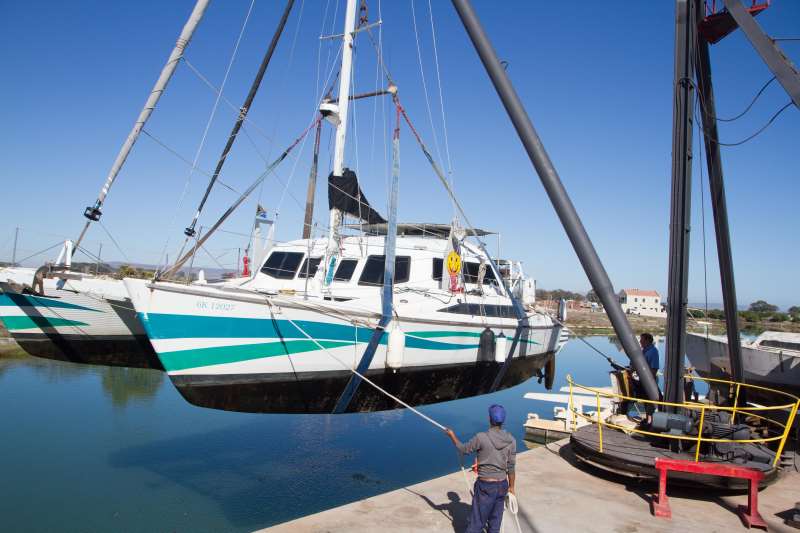
| Haulout in South Africa |
Our boat is quoted by the designer as "3.5 T empty" i.e. 3500 kg (7700 lbs) and 6T loaded (13,200 lbs). Certainly she was very light compared to any other 40' catamaran.
But we added the bridgedeck cabin structure (~1000 lbs, even when built in a pretty high-tech way), a diesel engine instead of outboards (say 400 lbs weight gain), scuba compressor (100 lbs), scuba gear for 3 (200 lbs?), my tools (shudder), two sewing machines, a big RIB with a 15HP engine, canning jars, spares for so much, boxes of stainless steel fasteners, sometimes 100's of cans of food when crossing oceans, cat litter, shoes... She is down on her lines about 4000 lbs from her empty weight. I'd bet she is probably 14,000 lbs in typical cruising conditions. So when full of gear, she is lighter than similar size production cats that are totally empty!
Tonnage
We'll close with a quick discussion of a number found on boat registration certificates. You might find Tonnage, Gross Tonnage, and Net Tonnage depending on your country.
These have nothing, repeat, nothing to do with your boat's weight.
Tonnage is a measure of the volume of a ship. Historically cargo ships was taxed on how many tuns or casks of wine they could carry. It simply refers to the volume of the ship. Gross Tonnage is the overall volume of the ship, Net tonnage is the volume of the cargo hold and is the value big ships are taxed on by various authorities because it's the measure of the earning power of the ship.
So if the harbour master asks you for your yacht tonnage, give him or her the net tonnage, because it's the lower number, and there is probably some sort of harbour dues based on tonnage!
Wikipedia has a good little article on tonnage here: Tonnage
Further reading: A good article by Phil Berman, a long time multihull sailor and boat broker. It's remarkably honest about the real weights of production catamarans
http://www.sailmagazine.com/multihulls/cruising-multihulls/14-things-remember-buying-catamaran/
- Evan
September 21, 2016
Exploring Curacao
![]() |
| Admiring the sea--which we do a lot... |
If ever we needed a hurricane hole, Spanish Waters in Curacao would be it. The large bay is entered through a
narrow channel, and once inside there are heaps of nooks and crannies. Compared
to Grenada
(which was chock-a-block), the place is half empty—and honestly, as a hurricane
season destination, we can’t figure out why.
![]() |
| Pretty Punda--a more colourful Amsterdam |
So far we rather like the place. It’s very arid—almost Arizona or Baja like: so
evenings are cool (ish) and days are only mostly stinking hot. But it’s a dry
heat. The anchorage may be the most comfortable we’ve been in, ever. Really. I’m
trying to recall a calmer anchorage with a more regular breeze… The only
downside is the ride to the dinghy dock is a bit far and if the trades are up,
it can be wet.
At anchor entertainment consists of watching all sorts of
small sailboats and windsurfers out for lessons and races—with nary a jet ski
in sight (or within hearing). There’s good public transit, as well as a free
shopping bus plus THREE big marine stores, a half dozen huge well-stocked
grocery stores (many which offer shuttle service back to the dinghy dock), a
great veggie market and, our latest find, The Wine Factory.
![]() |
| the floating bridge swings open for boat traffic |
Even though we were after some of the most affordable wines
Wine Factory manager Martin Jansen offered us tastes of everything, plus a
great bonus—for every twelve bottles we bought he gave us one free. All the
freebees were really special wines that he thought we’d enjoy. On top of the
lovely service they also offer free delivery.
![]() |
| definitely NOT the jungle |
So with our boat stocked back up for Latin
America we were free to explore. New friends gave us a couple of
tips while Evan was away in Baltimore (to reassure those who asked—he was
working for a Vancouver company in Baltimore—we’re not looking at a return to
the East Coast). The first tip was to save an hour or more on his airport entry
he should fill out an online ED card before flying back here: http://www.curacao.com/en/directory/plan/getting-curacao/online-ed-card/
The second tip was taxis are bloody expensive and it’s
actually cheaper to rent a car in advance then to take a cab from the airport
back to the boat. So we had a car.
![]() |
| cactus |
![]() |
| and caves |
The island has a lot to offer: There are a few national
parks, lots of museums, some great beaches and even a mall. We chose one park
rather randomly—we had a picnic, we were hungry and Shete Boka National Park was next up along the road.
The stunning landscape was enough to keep us happy—though the
heat took its toll. We look forward to more exploring before we set off again.
![]() |
| blowholes |
![]() |
| and beaches |
September 10, 2016
Out with the Old, In with the New
No, this isn't about replacing my spouse or child or cat.
It's about our boat batteries. We use 4 x 6V old fashioned lead acid golf cart batteries. They are not fancy. They are not super lightweight. But they are:
- relatively cheap to buy and replace when required
- have a decent lifespan (this is set #3, each set lasting about 3.5-4 years of heavy daily cycling)
- each one can be lifted without back strain (~64 lbs each)
- can be found in a lot of parts of the world, unlike AGM, Gel, or Li-Ion.
We thought the batteries were maybe starting to get tired in South Africa. But that was January, and we were spending money there like semi-sober sailors on boat gear. And in a Monty Python way, they weren't quite dead yet. So we decided to see if we could keep them going for a few months more. Which turned into 8 more months.
In St. Helena, where we spent 40 days in the lee of a big cliff, the sun didn't shine directly on the boat until late morning, so we had to run the engine an hour every other day. This was unheard of on our boat, which normally relies only on solar power. There, we also found one solar panel had died. So it now became time to replace the batteries. St. Helena and Ascension offer very limited shopping, though we probably could have found something in Suriname. But we were close to the boat gear shopping paradise that is the Caribbean (seriously, we haven't seen such well stocked chandleries since the west coast of the US in 2009)
(Easy way to test your solar panels: one person throws a towel over each panel in turn, and one person inside reads the amps coming in. A dead panel doesn't change the power coming in)
Budget Marine in Grenada offered reasonable pricing on batteries ($177 each) and a replacement 105W solar panel (~$200). This is about what I paid in Australia for the last set of batteries, and a bit more than 8 years ago for the first set.
New Solar Panel beside old one. The one on the right is the new 105 Watt one, the one on the left that is the same overall size is a 75 Watt one, donated by our friends Cindy and Doug, when they were upgrading their solar panels. It was about 10 years in service with us, and who knows how many on their boat with the previous owner. Look how the cells are cut from a much bigger silicon wafer and so are much efficient in terms of space compared to the older one.
Our solar panel farm keeps growing. The biggest panel in the middle is 200W, and we have a total of 550 W. Today, in bright sun, our peak power was running at about 33 Amps. That's like having an alternator running all the time. We love having a lot of solar panels.
- Evan
It's about our boat batteries. We use 4 x 6V old fashioned lead acid golf cart batteries. They are not fancy. They are not super lightweight. But they are:
- relatively cheap to buy and replace when required
- have a decent lifespan (this is set #3, each set lasting about 3.5-4 years of heavy daily cycling)
- each one can be lifted without back strain (~64 lbs each)
- can be found in a lot of parts of the world, unlike AGM, Gel, or Li-Ion.
![]() |
| Old bad batteries - heading for recycling ashore |
In St. Helena, where we spent 40 days in the lee of a big cliff, the sun didn't shine directly on the boat until late morning, so we had to run the engine an hour every other day. This was unheard of on our boat, which normally relies only on solar power. There, we also found one solar panel had died. So it now became time to replace the batteries. St. Helena and Ascension offer very limited shopping, though we probably could have found something in Suriname. But we were close to the boat gear shopping paradise that is the Caribbean (seriously, we haven't seen such well stocked chandleries since the west coast of the US in 2009)
(Easy way to test your solar panels: one person throws a towel over each panel in turn, and one person inside reads the amps coming in. A dead panel doesn't change the power coming in)
Budget Marine in Grenada offered reasonable pricing on batteries ($177 each) and a replacement 105W solar panel (~$200). This is about what I paid in Australia for the last set of batteries, and a bit more than 8 years ago for the first set.
New Solar Panel beside old one. The one on the right is the new 105 Watt one, the one on the left that is the same overall size is a 75 Watt one, donated by our friends Cindy and Doug, when they were upgrading their solar panels. It was about 10 years in service with us, and who knows how many on their boat with the previous owner. Look how the cells are cut from a much bigger silicon wafer and so are much efficient in terms of space compared to the older one.
Our solar panel farm keeps growing. The biggest panel in the middle is 200W, and we have a total of 550 W. Today, in bright sun, our peak power was running at about 33 Amps. That's like having an alternator running all the time. We love having a lot of solar panels.
- Evan
September 7, 2016
Birthday Waterspout
Peaceful easy sailing to Curacao for the first 300 miles-hoping it continues to hold. Celebrated Maia's birthday with cake and a Waterspout on the horizon.
This e-mail was delivered via satellite phone using Iridium Mail & Web software. Please be kind and keep your replies short.
September 4, 2016
Grenada: Boat parts and Zika
![]() |
| Our friend Mark wishes us and Crystal Blues goodbye as we leave Tobago |
![]() |
| Mohamed and Eva in the customs office also spent time with us on the beach--Mohamed and his wife Wendy became good friends |
After a month in Charlotteville, where the anchorage
contained 10-15 boats and we got to know the locals by name, Grenada has
been culture shock. From the sea we spotted multiple anchorages—and any one of
them contained more boats than the number that crossed the South Atlantic or Indian Ocean last year. When we pulled in after our
overnight sail from Tobago, both us and
Crystal Blues anchored on the outer edges and wondered what we’d gotten
ourselves into.
![]() |
| A tiny portion of one anchorage in Grenada |
It turns out we’ve arrived in a type of cruiser’s heaven (or
not heaven, depending on what you like). The morning net detailed a dizzying
number of activities from volleyball and jam sessions, to hikes and Mexican train
dominos (it’s like adult summer camp here). There are also shopping busses—although
the local transit is cheap and fantastic so we didn’t entirely understand the
point—and various marine services which deliver to your boat.
![]() |
| The yards here are popular for hurricane season haulout--we counted some boats packed in eight deep |
Then there are the marine chandleries. Over the past seven
years we’ve been thrilled if a hardware store had a part that could double as a
marine part. Occasionally we’ve come across a poorly stocked, uber expensive
marine store. But here there are TWO marine super stores which have all the
things we’ve been looking for at more-or-less affordable prices, as well as
stuff we always thought should exist but had never seen proof of.
Unfortunately Grenada
(unlike Tobago) also has super high levels of
Zika. The day before we planned to sail to Curacao,
Maia was complaining of very sore joints and developed a strange rash on her
face. Most people don’t get many symptoms from Zika—but Maia’s were so classic
we decided to stay put until she was over the worst of it.
![]() |
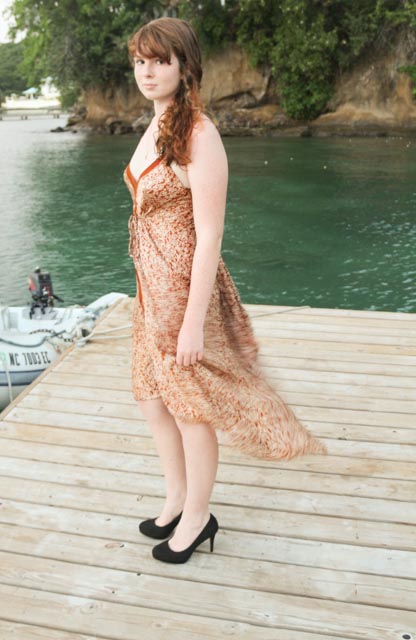
| Our lovely boat kid has acquired a variety of traditions from her travels--her first high heels for her quinceañera |
Sadly this means her 15th birthday won’t happen
in Curacao, but at sea. We’d already
celebrated a pre-birthday with Crystal Blues, when we thought we were going separate
ways, weeks ago but we thought we’d do another celebration—complete with a pair
of long-awaited high heeled shoes and a steel drum band.
Admittedly we’ve not seen as much of Grenada and we
wish we could. We managed to meet blogging friends from Zero-to-Cruising and
wandered around the main town of St Georges, but mostly our time has been spent
installing batteries and having one last goodbye evening with Ley and Neil (I think
we’re up to goodbye number 11 or 12…)
![]() |
| We've been lucky to have spent much of the past year with Ley and Neil and will miss them hugely when we part ways |
The final goodbye is looming though. Maia is recovering, the
weather looks agreeable and Evan has a flight booked out of Curacao
which he can’t miss.
August 27, 2016
Chilling in Tobago
![]() |
| We've seen four green flashes here and counting |
You know that life has reached its mellow zenith when the
biggest question of the day is, ‘what day is it, exactly?’ Followed by, ‘what day is tomorrow?’ Yes,
this was a real conversation—I won’t out the person (Neil) who had to have both today and tomorrow
clarified within a one hour period because that would be mean. Normally we just
ask about one or the other.
It’s easy here.
![]() |
| Lucille saw us walking past and called us in for breakfast of saltfish and local veggies |
We’ve spent more than a month in Tobago—but it only feels
like a week. The clue it’s been longer is the fact the entire village of
Charlotteville seems to know us now—and we know most of them. We know who to
get fish from and who to ask for lobster, or limes, or avocado or bread. We’ve
memorized the bus schedule and can recognize each fishing boat by its hull art.
![]() |
| local fishing boats go out in the morning to fish and transport tourists to remote beaches in the afternoon |
We have a gentle routine which includes paid work, boat
chores, reading, napping and an afternoon swim and sun downers. There’s a weekly beach BBQ (and Irwin is
helpful in getting us a breadfruit to BBQ while Mark gifted us a gorgeous fish.)
There are boats here from France, Germany, Scotland, Ireland, the US, Australia
and South America. Beach time contains a range of accents, languages and ideas.
![]() |
| Joe and his nephew Mark are two of our favorite fishermen |
It’s easy to do nothing but plan what to cook with the
abundant fresh food and watch the parrots cavort in the trees over the beach,
the pelicans dive on schooling fish and the local kids play in the water.
![]() |
| Maurice runs the sole tourist stand in Charlotteville |
It’s easy just to be in the moment and forget to record it.
Our camera has been tucked away, I haven’t been writing. We’re just living simply, simply living.
Maybe catching our breath before we set off again. Maybe letting the last two
years of experiences take root and take hold.
Maybe just taking it easy.
Subscribe to:
Posts (Atom)