This is a test to see if we can upload photos to the blog.
This e-mail was delivered via satellite phone using Iridium Mail & Web software. Please be kind and keep your replies short.
February 17, 2015
Iridium test
February 14, 2015
Indian Ocean FAQ’s (including the all-important pirate question)
![]() |
| Ceilydh from the sky, thanks to Brian from Delos |
So, where the heck
are you going and will there be pirates?
The most popular cruising route through the Indian Ocean
used to be from Sri Lanka
across to Yemen and into the
Gulf of Aden through the Suez Canal and into
the Med. But after a long civil war Somalia’s government collapsed. With
no government (hence no navy or coast guard) local fishermen lost their
livelihood to illegal fishing by foreign trawlers. Not surprisingly the
fishermen took it upon themselves to fight back and some of them discovered
stealing boats was more lucrative than fishing. Piracy soon emerged in the
unpatrolled waters off of Somalia
and even small yachts were attacked.
So we’re not going
that way.
Our plan is to go around South Africa—arriving there in time
for their summer (Nov/Dec/Jan). With that as a deadline, we have two basic
options. One is the Southern Route—boats leave later in the year and do longer
passages to Cocos Keeling, then the Mascarene Islands (Reunion and Rodrigues), on
to Madagascar and then Richards Bay, South Africa. The benefit is you get more
time in SE Asia and get the whole Indian Ocean
done quicker. The risk is you are making longer passages and are exposed to the
weather for much longer periods of time. This route tends to have stronger
winds and rougher seas.
We’re not going that
way either.
We’re departing on the Northern Route. This route will take us
eight months, or so, and give us a chance to visit some pint-sized countries
and remote atolls. From Langkawi we’ll be sailing about 1100 miles to Trincomalee, Sri Lanka. After a few weeks there,
we’ll head on for two months in the Republic of the Maldives—a
chain of 1,192 islands that stand in the Laccadive Sea
and where they speak Maldivian and spend rufiyaas to buy access to reportedly
great 4G.
From there we’ll head another 450 miles to the Salomon
Islands—part of the British Indian Ocean Territory (Chagos/ Diego Garcia) where
no one but sailors who are on their way across the Indian Ocean and sailors who
are part of the military are permitted to visit. From there it’s on to the Seychelles, Comoros
(which is the third-smallest African nation by area), Mayotte (an overseas
department of France), Madagascar, Mozambique
and South Africa.
Clearly we chose this route as a geography lesson for Maia. We also love the fact that four other teen boats are making the trip at the same time as us.
No, really, what
about pirates?
We would never go anywhere we didn’t feel was safe. But that
said, from the Maldives to Mozambique
we’re technically inside the ‘box’ where our yacht insurance won’t cover us for
acts of piracy. We’ve been monitoring the situation though and in 2012 a joint
action by several countries and shipping agencies successfully disrupted piracy
to such a degree that yachts are beginning to go through the Suez
Canal again. The region we’ll be in hasn’t seen any recent pirate
activity at all.
We will pay careful attention though—there are a variety of
agencies that track acts of piracy. If we feel it’s warranted we may change our
route or got into ‘stealth mode’ where we stop reporting our position publicly.
How do you plan to
communicate (in case of pirates)?
We’ve been really happy with our SSB. Combined with our Pactor
modem we’ve never felt isolated and have been able to participate in nets, get
weather and send emails. This said, it turns out there is a pretty significant
gap in the Indian Ocean where reaching a Sailmail
station (the way we get our weather and email) becomes tricky. This is also the
area of the Indian Ocean that we’d want to be
really up to date on any piracy concerns.
So with that in mind, for the first time in our lives we’re
early adopters and have purchased an Iridium Go (a black box that lets us use
our smart phone as a satellite phone and internet device). From what we’ve
heard the reliability is emerging and they have a lot of bugs—but between the
technologies we feel pretty confident.
In case of an emergency we’d set off our EPIRB.
I saw that beer photo
from your friend’s boat, isn’t there any beer out there? Do pirates drink beer?
No idea on the modern pirate’s beverage of choice, but it
turns out one of the reasons yachts love Langkawi is that it’s duty free. If
you’ve ever bought a bottle of wine in a Muslim country (or a rasher of bacon)
you’ll know intoxicants and the pig are both haram and therefore both very
spendy.
While there is no help for bacon lovers in Langkawi (you’ll
need to carry on to Thailand
for that—or spend big in the teeny-tiny non-halal section of the grocery store)
sailors who imbibe tend to stock up the way anyone would stock up when they
have unlimited access to $11 a litre gin.
What other
provisioning have you done?
The countries on our route for the next eight months are
very small, isolated and poor. We’ll find the basics; so far every country
we’ve visited has had lots of starch options (rice, taro, cassava, pasta, white
flour…), onions, green beans and tomatoes have been consistent, as has some
sort of tropical fruit, most have UHT milk and some sort of processed cheese,
chicken and eggs are plentiful, as is tinned tuna and spam, some sort of bean
or legume is usually around (though it may be hosting a protein)—so there’s
always something to eat. What we buy are all the things to make a basic diet
more interesting; everything from nice cheeses and long life cream, to tinned
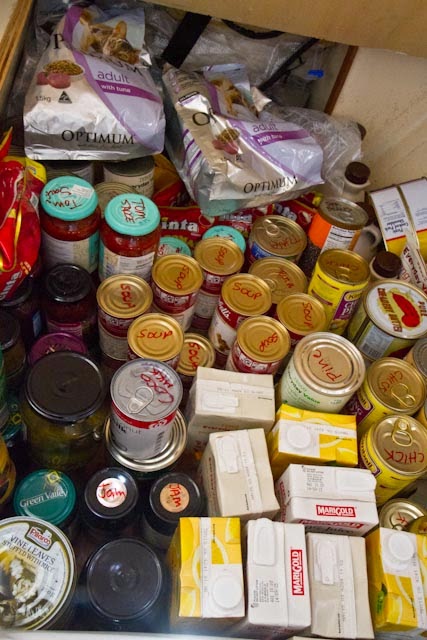
corn, olives and capers, to baking supplies.We also buy easy 'at sea' food when we find it. Maia insisted we buy out a store's entire stock of American clam chowder.
We also are restocking our medical kit and picking up a
year’s worth of prescriptions and contact lenses. For the boat we’re making
sure each system is in good shape after the last eight months of constant
travel (cruising is like a dog’s year for a boat. One year of full-time
cruising = 7 years at the dock.) and restocking the spares we went through.
Last but not least we're also stocking up on eight months of cat food and kitty litter. That's the way to keep a boat light...
February 11, 2015
Ode to the Boat Part in Transit
I must go down to the seas again, to the lonely sea
and the sky,
And all I ask is a working windlass, a new starter
motor, a waterproof hatch and a satellite phone to get weather by;
And the wheel’s kick and the wind’s song and the white
sail’s shaking,
And a grey mist on the sea’s face, and a grey dawn
breaking,
I must go down to the seas again, for the call of the
running tide
Is a wild call and a clear call that may not be
denied;
And all I ask is a few more prescription meds (why
does each chemist only carry a one month supply of each drug?), a new dagger
board and a repaired mast tang to keep the sails flying,
And the flung spray and the blown spume, and the
sea-gulls crying.
![]() |
| replacing the hatch that leaked with an 'A' rated waterproof one--note the new wood at the front of the cat walk--the old one was smashed on the Borneo passage |
We’re anchored in Telaga harbour on Langkawi island up to
our eyeballs in projects (they multiply once you start) while waiting for
packages to arrive. As a duty free port, Langkawi is a favourite with sailors
who need stuff. If you throw a whole lot of money at a spare part you can get
things within a week from the US.
For example we need four springs for our Quick brand windlass which should cost
a dollar each, BUT the rectangular shaped springs only come as a unit with the
brushes for $145—add expedited courier fees and that $4 item will be responsible
for our diet of beans and rice for the next month…
![]() |
| Boxes of parts = more projects. Also sent our spare alternator off for an overhaul while we were here |
Every second boat we talk to is waiting for parts to arrive.
DHL is known to arrive here quickly (and we’ve been giving them our money by
the reluctant fistful to excellent result) while both FedEx and USPS both seem
to take a nearly as expensive but much more scenic route to Langkawi.
![]() |
| It's a busy time of year and we couldn't hire anyone to do it so Evan rented space and tools at a shipyard to build a new dagger board |
As places go to work through projects and wait for parts this
one isn’t bad. The anchorage is flat calm and well protected, there’s easy
shore access for fuel, laundry and water etc. There isn’t much for shops or
cheap restaurants in the immediate area but the marina rents cars during the
day for a few dollars an hour—so we’re able to make runs into Kuah and collect
up all the parts we need.
![]() |
| Charlie is just happy that it's calm |
We are on a deadline though—two of our kidboat friends are
on their way to Trincomalle,
Sri Lanka and
we’re keen to catch up for some inland adventuring. So if you wouldn’t mind
sending a few ‘fair winds’ thoughts out to our stupidly expensive windlass
motor springs to hurry them on their way, we’d be obliged.
I must go down to the seas again, to the vagrant gypsy
life,
To the gull’s way and the whale’s way where the wind’s
like a whetted knife;
And all I ask is a merry, ‘ Yes we have that part!’ from
a laughing shop-owner,
And quiet sleep and a sweet dream when the long
trick’s over.
- with apologies to John Masefield
February 8, 2015
The Support Team
All long term cruisers need somebody back home to help out. Some people use a commercial service, but frankly I'm not too keen on trusting all my financial affairs to a stranger. Most of us use a trusted friend or family member. Last time we cruised it was my mom and dad. But they're a bit older and they did it once already. Nobody should have to do it twice!
Carolyne, my sister-in-law, has been quietly and efficiently helping us manage our affairs for the past several years. She does it for love, not the minimal amount she charges for what I suspect is more time than she tells us. She reminds us of when we haven't paid our credit card bills, receives our mail, sends out cheques to obscure mail order vendors, get parts in the mail for future trans-shipment to some exotic port, deposits Diane's writing earnings, argues with our bank when we need new ATM cards, pays our property taxes, our medical bills, Maia's RESP contributions, and untold other tasks that escape my tired brain this evening. She also stores half a dozen cardboard boxes in her garage that our remaining ties to a land bound life.
So let's all give a cheer to Carolyne, the unsung hero back home who keeps this cruising family going, and never receives much more than a thanks from us. Those of you out cruising know how important this person is, and if you're planning to go sailing one day, I only hope there's somebody out there that has your back the way she does for us.
- Evan
Carolyne, my sister-in-law, has been quietly and efficiently helping us manage our affairs for the past several years. She does it for love, not the minimal amount she charges for what I suspect is more time than she tells us. She reminds us of when we haven't paid our credit card bills, receives our mail, sends out cheques to obscure mail order vendors, get parts in the mail for future trans-shipment to some exotic port, deposits Diane's writing earnings, argues with our bank when we need new ATM cards, pays our property taxes, our medical bills, Maia's RESP contributions, and untold other tasks that escape my tired brain this evening. She also stores half a dozen cardboard boxes in her garage that our remaining ties to a land bound life.
So let's all give a cheer to Carolyne, the unsung hero back home who keeps this cruising family going, and never receives much more than a thanks from us. Those of you out cruising know how important this person is, and if you're planning to go sailing one day, I only hope there's somebody out there that has your back the way she does for us.
- Evan
February 3, 2015
15,000 miles for Pizza
![]() |
| Were they ever this young? Learning about tsunamis when a little one hit La Cruz |
Exactly five years ago in La Cruz, Mexico we were
invited to our friend’s boat, Totem for pizza. When we got there though rather
than being served ‘the best pizza in the world’ (which we had been told about
in great and sumptuous detail) we were given a meal of fresh seared tuna. Not
shabby, but not the much lauded BPIW.
![]() |
| Mexico |
![]() |
| Malaysia |
Luckily the Totems are cool people and we enjoyed hanging out
with them even if they lied about the menu. The kids played for hours and days
on end, Behan and I would go for long walks, Evan and Jamie would do boat
stuff. With a few weeks to go before they planned to jump off for their pacific
crossing they promised the BPIW would still happen.
![]() |
| Mexico |
![]() | |
| Australia |
![]() | |
| Malaysia |
But it didn’t. Other meals happened; there were tacos on
shore, and potlucks, and a final farewell dinner. And as we waved goodbye when
they set off for Australia,
Jamie told us we’d just have to meet them in Australia for his pizza.
So two years later we did just that. The kids were bigger,
the seasons were upside down, but the family was still very cool. We had a lot
of meals together; there was Korean food with Scotch for Gung Haggis Fat
Australia Day (Robbie Burns/Chinese New Year/AU day), corned beef and cabbage
for St Patrick’s, Aussie BBQ’s on shore and even take out pizza. But six months
after reconnecting with them, Totem was again on their way. And when I asked
about the long-promised, but never-delivered, BPIW Jamie told us to meet them
in Malaysia.
![]() |
| Australia |
I’m not sure about you, but traveling 15,000 miles for pizza
seems like a lot. Even for really good pizza. But I looked at it this way—if we’re
headed around the world anyway, why not get a meal out of the deal? So we put
the coals on to catch Totem before they set off for South Africa. Our original plan saw
us overlapping with them for about a week. We gave Jamie plenty of notice and
let them know we were coming for dinner.
![]() |
| Malaysia |
The pizza was great: completely worth the years and miles.
Or maybe what was worth it was the discovery that even as nomadic families who
have been following our own paths it’s possible to forge a deep, enduring and
recurring connection.
One of the questions we’re often asked is how Maia finds and
keeps friends. The vision of us passing by on the edges of other people’s lives
was one that also one that worried me. I love the history that comes with long-term
friendships. I wanted Maia to have grown-up with
other kids; to see her own changes reflected in them. That’s hard to find
when your childhood spans dozens of countries.
So maybe the pizza wasn’t just a pizza. Maybe the best part of
that dinner was catching up with dear friends and having a chance to both reminisce
about the past and look ahead to our voyage to South Africa—with the very same
people.
![]() |
| Mexico |
![]() |
| Australia |
Or maybe we just take meal invitations really seriously and
if you ever invite us for dinner you better really, really mean it.
January 28, 2015
Medical tourism
Today I flew to Penang (Pinang), the local centre of medical tourism in Malaysia, for a consultation with a cardiologist. There are 4 big hospitals in Penang. The local hospital in Langkawi, where we are, is not well regarded.
From what the cardiologist was able to determine today, my heart is fine. We'll see if blood test results show anything else soon.
Here's the breakdown of costs (in $USD) for those interested in how
much medical care costs here without any sort of insurance.
Taxis to/from airports (4 cab rides) = $40
Lunch at the hospital = $6
Very short flights to/from Penang on AirAsia = $34 return
Cardiologist Consult = $33
EKG = $13
Echocardiogram = $80
Blood tests = $100
Admin fee = $3
Total = $309.
That's a pretty good deal considering a lot of the above was transport. According to one of my cab drivers, the Gleneagles hospital where I went is the most expensive of all the big 4 private hospitals!
- Evan
From what the cardiologist was able to determine today, my heart is fine. We'll see if blood test results show anything else soon.
![]() |
| The Blood Testing Lab |
Taxis to/from airports (4 cab rides) = $40
Lunch at the hospital = $6
Very short flights to/from Penang on AirAsia = $34 return
Cardiologist Consult = $33
EKG = $13
Echocardiogram = $80
Blood tests = $100
Admin fee = $3
Total = $309.
That's a pretty good deal considering a lot of the above was transport. According to one of my cab drivers, the Gleneagles hospital where I went is the most expensive of all the big 4 private hospitals!
- Evan
January 19, 2015
The Plans They are a Changing
![]() |
| Singapore in the distance |
Every time we run into a cruiser we haven't seen for a while one
of the first questions is, "what are your plans?" It's not that we
forgot their original plans (though it can be hard to keep track) it's more the
fact that cruising plans are, as they say, 'written in sand at low tide.'
Depending on boat repairs, the strength of your home currency (last
time we cruised our cheeseburgers in paradise suddenly got really expensive
when the Canadian $ went into a steep decline), the health and happiness of
crew and family at home, and a dozen other factors plans can change without
warning.
Our plan had been to kick around South East
Asia for the next year. We wanted to do some inland travel in Cambodia and Vietnam,
spruce up the boat in Thailand,
do some writing... But then last week Evan and I celebrated the 29th
anniversary of meeting each other and starting to date. We were children…
![]() |
| threading our way through the freighters to Puteri Harbor |
As we tallied up our life: 30,000 sea miles, living and working in
a handful of different countries, friends around the globe--one detail stuck
out: We've been living on boats, away from Canada for fully half of those years.
Then Maia pointed out that for her it's been over half her life. Somehow, in a
five minute chat, we all decided it was time to point for home.
There are other factors: Maia’s growing up faster than we can keep
up with and as much as she loves cruising and travel her taste of high school
has made her decide she wants to finish out her schooling in a school. And Evan
and I both really want to spend more time with our parents and siblings—not to
mention the old friends we have at home.
So that's what we're doing. We'll be taking off to cross the Indian Ocean in a few weeks (we'll share more about our route in the next post). One big bonus is that a
number of other boats we've met along the way, including our good friends on
Totem, had already committed to the big trek to South Africa. And because Behan
from Totem is a planning guru (we used all her spreadsheets for crossing the
Pacific) we feel fairly organized. Though honestly, that fades a bit with each
day we get closer to our planned D-day…
We still have a number of repairs to make but we've already taken
a dent out of our provisioning needs and feel pretty confident that somehow it
will all come together. So South
Africa or bust!
January 15, 2015
Glad that's done
After crossing part of the South China Sea, we arrived this afternoon at the islands just south of Singapore. We are all in agreement that was probably our hardest slog ever. It was a 300 mile beat to windward, close hauled all the way, in about 15-20 knots of wind. And a bit of a 2-3m cross swell. And sometimes a 2m right in our face swell or residual wind waves. Horrible steep confused seas for almost the whole time. We stuffed the bows hundreds of times. One bow locker accumulated about 10 gallons of water. A forward berth hatch leaked, getting all Maia's stuffed animals damp.
Casualties:
- starboard daggerboard lower section broke off in heavy seas. It was the 'old' one - the port one was repaired in Fiji. I suspect the wood cores get wet and the fatigue of 25 years of service gives them a finite lifespan
- autopilot steering ram sort of stopped working at night. I swapped in a spare one so that wasn't too much drama.
- the genoa furling line broke. Twice. The first time in a squall when it unrolled very suddenly. We found the chafe point on the furler drum just before it went a third time.
- A few spots of the trampolines came undone in the big seas
- the forward catwalk/swim ladder broke apart, leaving it only semi-intact, a victim of constant bashing at speed.
- a running backstay fitting started pulling through the cabin top
- Fred the cactus took a bad fall, but we are hopeful he will pull through.
We will take 2 days to get to Puteri Marina in Malaysia but that's just day passages in mostly shelter waters. Whew. Now we just have to dodge the hundreds of freighters in front of Singapore.
- Evan
----------
radio email processed by SailMail
for information see: http://www.sailmail.com
Casualties:
- starboard daggerboard lower section broke off in heavy seas. It was the 'old' one - the port one was repaired in Fiji. I suspect the wood cores get wet and the fatigue of 25 years of service gives them a finite lifespan
- autopilot steering ram sort of stopped working at night. I swapped in a spare one so that wasn't too much drama.
- the genoa furling line broke. Twice. The first time in a squall when it unrolled very suddenly. We found the chafe point on the furler drum just before it went a third time.
- A few spots of the trampolines came undone in the big seas
- the forward catwalk/swim ladder broke apart, leaving it only semi-intact, a victim of constant bashing at speed.
- a running backstay fitting started pulling through the cabin top
- Fred the cactus took a bad fall, but we are hopeful he will pull through.
We will take 2 days to get to Puteri Marina in Malaysia but that's just day passages in mostly shelter waters. Whew. Now we just have to dodge the hundreds of freighters in front of Singapore.
- Evan
----------
radio email processed by SailMail
for information see: http://www.sailmail.com
January 12, 2015
Some days are like this
Today I started with a small project - change a topping lift wire that had lost some of its vinyl covering to a more sail friendly Spectra line.
We use the windlass to raise me up the mast, so I went to start the engine to keep the battery charged while using the windlass. "Click" went the starter motor. Uh-oh. While not in the middle of nowhere, you can see it from here. The nearest place we could maybe get something like a starter motor fixed is the city of Pontianak, some 80 miles up a river from here (no roads in this part of the world). So instead of climbing the mast, I get to troubleshoot the starter motor.
Wires are fine, lots of voltage, battery charged, connections mostly corrosion free but hit them with some sandpaper and wire brush, take apart the starter motor and it's looking good. Trouble must be a sticky solenoid. So I whack it a bit, squirt some miracle product into it, and when re-assembled, the starter works again. Whew. 2 hours into the 10 minute job, and I'm ready to begin. The topping lift replacement goes smoothly, but as I'm being lowered from the masthead, I stop at all the shrouds and look them over. Get to the lower shroud tangs and holy shit - one is fractured right apart. These are some nifty titanium tangs we refitted in Fiji. They have had a history of cracking at the bends and sure enough, ours have. I really wished I had taken the supplier's offer to replace them with stainless steel ones when their problem first arose.
So it's back down to the deck and start scrounging through the spare materials bin to see what I can use to replace the cracked tang. Surprisingly there is a lack of titanium flat bar but I do have some aluminum angle of the right thickness and width. So I cut off one leg of the angle, drill the required holes (1/2" holes with a hand drill are fun) and bend it with some clamps and a hammer. It looks pretty good for a jury fix. Titanium and aluminum aren't too far apart in stiffness so they won't share the load exactly equally but for getting us 300 miles across the South China Sea and coastal hopping to Langkawi it will do o.k. If I hadn't the aluminum I would have laid up a carbon fiber strap using the old tang as a mold or even plain fiberglass (would have been thick but it would have been strong enough).
Back up the mast, replace the shrouds, down to the deck, and re-tighten. I manage to do a few more minor running rigging replacement jobs that have been nagging my conscience a bit. The exploding furling line the other night makes me watch the ropes a bit more carefully.
So my 10 minute job took about 4 hours due to other failures along the way. While not typical, it's not that unusual either. The best sailors are the ones that keep trying when things go wrong we were telling a friend recently. Tomorrow morning we set sail for the islands to the South of Singapore. Maybe Malaysia in about 5 or 6 days if the weather is O.K.
- Evan
----------
radio email processed by SailMail
for information see: http://www.sailmail.com
We use the windlass to raise me up the mast, so I went to start the engine to keep the battery charged while using the windlass. "Click" went the starter motor. Uh-oh. While not in the middle of nowhere, you can see it from here. The nearest place we could maybe get something like a starter motor fixed is the city of Pontianak, some 80 miles up a river from here (no roads in this part of the world). So instead of climbing the mast, I get to troubleshoot the starter motor.
Wires are fine, lots of voltage, battery charged, connections mostly corrosion free but hit them with some sandpaper and wire brush, take apart the starter motor and it's looking good. Trouble must be a sticky solenoid. So I whack it a bit, squirt some miracle product into it, and when re-assembled, the starter works again. Whew. 2 hours into the 10 minute job, and I'm ready to begin. The topping lift replacement goes smoothly, but as I'm being lowered from the masthead, I stop at all the shrouds and look them over. Get to the lower shroud tangs and holy shit - one is fractured right apart. These are some nifty titanium tangs we refitted in Fiji. They have had a history of cracking at the bends and sure enough, ours have. I really wished I had taken the supplier's offer to replace them with stainless steel ones when their problem first arose.
So it's back down to the deck and start scrounging through the spare materials bin to see what I can use to replace the cracked tang. Surprisingly there is a lack of titanium flat bar but I do have some aluminum angle of the right thickness and width. So I cut off one leg of the angle, drill the required holes (1/2" holes with a hand drill are fun) and bend it with some clamps and a hammer. It looks pretty good for a jury fix. Titanium and aluminum aren't too far apart in stiffness so they won't share the load exactly equally but for getting us 300 miles across the South China Sea and coastal hopping to Langkawi it will do o.k. If I hadn't the aluminum I would have laid up a carbon fiber strap using the old tang as a mold or even plain fiberglass (would have been thick but it would have been strong enough).
Back up the mast, replace the shrouds, down to the deck, and re-tighten. I manage to do a few more minor running rigging replacement jobs that have been nagging my conscience a bit. The exploding furling line the other night makes me watch the ropes a bit more carefully.
So my 10 minute job took about 4 hours due to other failures along the way. While not typical, it's not that unusual either. The best sailors are the ones that keep trying when things go wrong we were telling a friend recently. Tomorrow morning we set sail for the islands to the South of Singapore. Maybe Malaysia in about 5 or 6 days if the weather is O.K.
- Evan
----------
radio email processed by SailMail
for information see: http://www.sailmail.com
January 8, 2015
Yes, Virginia, There Really Are Storms and Pirates Out Here. (Parent alert: just skip this post)
![]() |
| Friendly police with a serious warning--we're in an area known for pirates, so please take their mobile number in case we're attacked. |
At some point last night, when my vertigo was at its worst,
and the boat seemed to be revolving in a clockwise fashion with distressing
speed, I tried to focus on one bow to settle the motion. It might have been the
drugs—but rather than relieving my vertigo, forcing myself to focus made me
feel like I was in the fakest-looking storm sequence ever filmed. Our boat
looked like it was in a wave tank—with waves coming every which way. Buckets of
water seemed to be hurtled at us from just off camera. Occasionally a flash of
lightning would illuminate the entire amateur scene. While it was a bit strange
to be so disconnected—the bonus was I didn’t feel even slightly concerned about
the weather. If the rough seas looked that phony, clearly things were fine.
A while back Evan and I came across and article (survey?)
about qualities every successful blue water sailor shares (I’d hunt down the
link but have limited internet—but if this rings a bell and you know the source
please post it in the comments). The results looked at cruisers who have lasted
for years on the water. It turned out sailing has less to do with finances,
perfect boats and text-book sailing skills and more to with grit, and the
ability to puzzle through complications without quitting, than most of us
imagine. In other words—the sailors who keep going are the ones who don’t give
up during the tough moments, instead they try one-more-idea.
This answer makes tons of sense to me. I have to say our
sailing friends are some of the most stubborn people I know—pile the problems
on and they’ll just keep solving them. The flip side of this is that most of
the long term sailors we know are also really cautious. They take calculated
risks and don’t worry too much about not making a destination as planned, when
planned. To borrow a little Kenny Rogers’ they know when to walk away and know when
to run…
We just ran away. Rather than being in Malaysia with decent internet we're somewhere
deep in Borneo with sketchy internet. The last
three days passed in a seasick haze, punctuated by crisis. Take Two of Get to Malaysia was
one of the worst passages we've ever had and took more consecutive grit from
Evan (who already has a medical worry at the back of his mind) than he’s needed
so far.
When we came out of the Kumai River
we knew we had an initial upwind/against current slog. But the winds were forecast
to be light so we expected we’d make more than 2 knots in seriously obnoxious
seas. But 2 knots it was (think toddler walking speed) and within a few hours I
was bright green. By the time conditions eased off, the fishing boats had also come
out to catch up for days of being harbour bound. We miscalculated which net
belonged to which boat caught a net around the prop. This meant Ev jumped into
the murky water at 3am and spent for an hour in bouncy seas working to cut us
free (at least it got him a bath so he smelled better than me...).
Our second day and night don’t seem to come with any
distinct memories. I vaguely recall Evan encouraging me to sip water and try to
eat. And I know I kept a few watches so he could get some sleep—but the upwind
sailing in rough seas pushed me into the worst seasickness I’ve ever
experienced, mostly I was in a stupor.
By the third night we thought we might be okay. Every few
hours we’d get smoother conditions—enough to get food or water. We were making
good speed under genoa alone (so many squalls came through that it was easier
to only have one sail to reef) and then the jib furling line broke in the
middle of a squall sucking Evan's hand into the winch (it's swollen but okay).
Evan pointed the boat downwind (which had the unfortunate
coincidence of being in the same place land was) and I woke Maia at 3am for the
second time. Donning our harnesses we worked together to secure the sail and
got the boat turned back on course in the nick of time. According to the
weather reports if we fixed the furler at sea our current weather window still
has just enough of an opening to get us to Malaysia.
![]() |
| the calm river water was a beautiful sight-even with all the fish traps we needed to dodge |
But instead we followed a tug into a river this morning.
We’re anchored. Evan is sleeping. There will always be another weather window.
Know when to fold’em.
And…the police just pulled up. Apparently we’re anchored in an
area of known pirate activity. They’re moving us to a village we didn’t see and
giving us a cell number to call if we’re boarded. Umm, thanks?! They’re also
getting us more diesel fuel—gotta love a full-service piracy alert.
Subscribe to:
Posts (Atom)