August 15, 2013

New camera lens

We got a new camera lens for my birthday in April and I've been remiss in not posting a few photos using it.  It's a Canon EF-S 10-22mm F3.5-4.5.  For non camera geeks that's a ultra wide angle lens for APS-C (smaller than full 35mm size sensor).  In 35mm terms it has the same focal length as a 16-35mm lens.

I can now see why photojournalists would often keep a very wide angle zoom on one body all the time. It can capture a huge scene but is also useful in crowded environments in getting close to a subject and showing their surroundings to give context. Its challenging to use because of perspective distortion at the edges of the frame. But it can give spectacular results. 


This isn't the sharpest example because light levels were falling and I was shooting at 1/15 sec. 
Still pretty decent


Brisbane's New City hall opening


 Woo Hoo.  Capture from deck to masthead without tilting the lens up! 

For those keeping score we're now up to 6 lenses...
http://maiaaboard.blogspot.com.au/2012/04/cameras-for-cruising-technical-boring.html

Miracle Glue

It was time to change our bimini awning.  We had it sewn in Mexico but the fellow in La Cruz had used plated steel grommets.  The perimeter was a rusty mess, the fabric was a bit sun rotted and was totally porous.  Rain would pour through it. Green mold livened up the underside.

We changed from Sunbrella to PVC coated polyester.  That's the heavy duty fabric you might see as tarps on the sides of delivery trucks.  It's quite sturdy and we used it as a sun awning on our last boat for many years.  It's totally waterproof which works well if you want to use it to catch rain.

At the Sanctuary Cove boat show there were the usual 'miracle' products available. Then there was the couple flogging this PVC/vinyl glue.  They had nice samples glued together for you to try to tear.  The PVC would go before the glue would release.  We also found it on Sailrite's website and we think they're good folks who wouldn't sell junk so be bought a tin to try.  Apparently it's also useful for hypalon dinghy semi short term repairs (like up to 1 year).


We decided to glue our awning together.  Seams and all.  We laid it out, cut the pieces on a nearby dock which was big enough.  Took about 1 hour to glue the seams joining the panels and the overlaps on the perimeter which form the method to attach awning to frame.  If we had sewn it, it would have taken many more hours and there would have been much strong language (as there always is with our big sewing projects).

Results:

It's been a few months and no issues at all.  We had one downpour where huge amounts of water were pooling in the awning and bowing the fabric downward.  No problem - and because the seams are glued not sewn, no water leaks through.

Simple lapped seam

 I was so happy with the end result that I glued together a dinghy gas can cover in about 10 minutes. 


Here's the perimeter seam with an internal PVC pipe.  We cut scallops every 6" or so for lashing string to tension to the bimini frame. Much cheaper than 100 grommets and no chafe on the string.

We're pretty impressed with it.  A few hints:  

  • it acts like contact cement.  Coat both surfaces, wait 5 minutes and join.  You get only 1 chance to position a seam right.  
  • Directions ask you to roll the seams with a hard roller. I hit it hard instead.  
  • For designing joints/seams try to keep the joint in shear
  • A simple overlap is plenty strong enough.  
  • Avoid joints where the fabric is in "peel".  In other words where the force acts first on a tiny portion of the joint peeling apart the joint.  See example below
  •  

July 14, 2013

Growing Up Afloat


I’m not sure how most parents mark the passing of their kid’s years but for us, alongside the height marks on the wall, and the outgrown shoes, we’ve noticed Maia’s developing maturity by changes in our anchoring routine.
 
Maia at three
There was a time when she was very wee that when the moment came to anchor I’d strap her into her car seat and try to chant to myself, ‘it’s for the good of the boat’ while Maia protested very vocally and Evan tried to get my attention with hand signals before dropping the hook. Then came the stage where we would talk to her in advance, explaining she needed to play quietly and not interupt us with questions until the anchor was down and the engine was turned off. Sometimes if it was going to be complicated anchoring or docking we’d even pull out special toys. 

“Is the engine off yet? No? Then please wait to talk to us.”

By the time she was seven she knew the drill and would tuck herself away with a book until the boat was silent and settled, and then we could look out at the new neighbourhood together.
 
off on her own exploring
 

Then came the latest change, “I’d like to learn to anchor the boat.”

Our parenting style falls somewhere between ‘high expectations’ and ‘childhood is short and the magic should be protected’. What this means is when Maia brought home a recent report card we barely looked at it but asked if she’s having fun learning and is getting everything out of school she hoped. On the boat it means we expect her to help with every chore but if her imaginary mermaid friend wants to help too, we’ll get both of them a scrub brush.
 
school holidays are even better with a friend along
 

So through the years Maia has ‘helped’ but it was more about teaching her how to do things, and how to be part of a crew, than actually getting things done. Recently though this has changed. Along with bigger feet, and a height mark on the wall I no longer have to bend down to make, the way Maia helps us indicates she’s growing up. When we were hauled out to paint the bottom the quantity and quality of her contribution caught us both off guard. But it wasn’t until we went out sailing afterward that we really saw that our little girl had grown into a sailor.

And as she set the anchor and helped stow away gear, and made her friend feel at home and taught her how to use everything on the boat, we discovered we're sailing with a very different person than we arrived in Australia with. And I couldn’t help but feel proud and amazed.

“I’m not sure a boat will be my dream when I’m an adult,” Maia told me one evening as we watched the sun set beyond our anchorage, “but it’s a good way to grow up.”
scenes from our latest trip out


July 11, 2013

Haul out costs

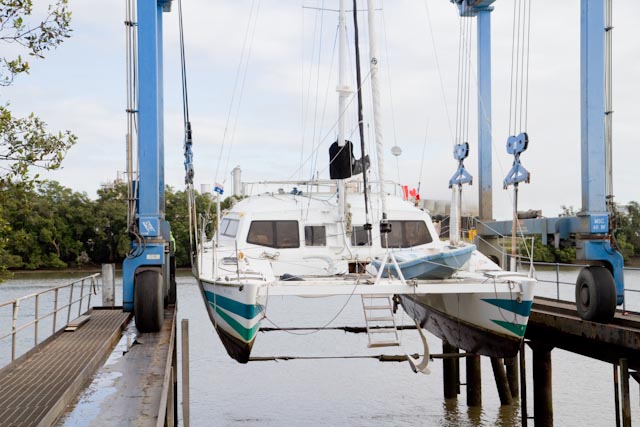
Just a follow up about hauling out costs for a 40' catamaran at Brisbane Marine Industry Park

Lift in and Out. Blocking.   $400

Pressure wash (till it was clean, not by the hour).    $168 (2 guys for about 2 hours)

Each night on the hard. $71

Ladder rental $5/day

Optional:
Had to buy a 16A DC 240V battery charger to run my 120 V sander via the inverter. $120
About 60 sanding discs.  - already on the boat but probably cost $20 when purchased some time ago
10 L Jotun Seaguardian anti fouling $275 ( wholesale pricing because my company buys $1000s of paint from them ).  Retail is about $450 locally.  10 L gave us 2 very good coats.

 - Evan

July 4, 2013

The Hard Life-Australia


Hauling out is difficult, time consuming and expensive (and occasionally dramatic). So we tend to put it off. In fact, the last time we hauled the boat up onto dry land to paint the bottom was May 2010 (we had such a terrible paint job done at Abaroa’s we ended up careening the boat in September 2010 and adding another coat of paint). This time we were hoping to eek every last bit of use out of our paint, which we did, plus a year or so. About a month ago when scraped a barnacle farm off the boat we knew it was past time.
 
we just fit
Anyone with a cat can tell you finding a place to haul takes a bit of research. Because of our width we tend to need travel lifts designed for really big boats—which leads to a really big price. Our strategy is to hunt out smaller-extra wide lifts in industrial boat-yards, which means we end up in interesting places. But the price tends to be slightly more manageable.
 
barnacles, weed and river goo
This time we ended up in Brisbane Marine Industry Park on the little lift—which Ev had carefully measured and saw we *just* fit on. Though it was a narrow slot, and the current was on our beam, getting into the lift was drama free (yay!). Once the boat was out (Maia: “Oh, I love the smell of a boatyard!”) and we looked over the hull (Evan to yard worker: “It’s not so bad, is it?” Yard worker with bemused look: “It’s filthy.”) we were moved to our spot and the work started. And so did the rain.


looking at the bend in the rudder--this one is slated for replacement shortly

Winter in Brisbane is dry season. You can ask locals and many will tell you about years that went by without measurable rain in June or July. This year though: record breaking. It’s been raining so much it seems to have thrown the weather forecasters off their game. The weekend, which was supposed to include an occasional shower, turned into one big rain fest. We ended up draping the boat with everything tarp-like we own (including the tent) in an effort to keep the hulls dry enough to paint.

Then we ran into another problem. North American power tools don’t run on the Aussie 240 outlets and when it rains non-stop there isn’t much sun available to charge solar panels. A quick trip (with a borrowed car) to the hardware store for a battery charger (and more tarps) solved the problem though.


Once we were set up it was time to start sanding. Problem #3 was the discovery that 18 months in brackish water had lead to the development of some osmotic blistering. We had the same thing happen on little Ceilydh after her time in the Rio Dulce—not sure of the science behind it but the blisters were pencil eraser to dime sized and none went into the glass. We treated them by popping them open, rinsing them well, and then any that need filler after sanding were filled.
a few of the little blisters we found after they were opened and dried...
Next came a couple of coats of paint, a few minor repairs and after four days it was back into the water on a bright sunny winter day and out on the bay for a short sailing holiday.

The paint is supposed to be 30 month paint—which I’m sure we can stretch….

June 18, 2013

Changing Seasons = boat chores


Saying goodbye happens more in this life than most--but at least we know we'll see these wonderful people again someday
The other day, as I made dinner, our boat rang out with giggles and a familiar French/English conversation. A few hours later Maia cried herself to sleep after yet another goodbye—her sweet friends Cami and Rose (and their fab parents JF and Melanie) are on their way back to Quebec. The family that we first met in Nuku Hiva has sold Dorénavant and after four years they’re headed home.


I feel like I write endlessly about how the currents of this lifestyle carry people in and out of our lives. Part of coming to Australia was to take a break from the goodbyes—but of course just because we might stay in one place doesn’t mean the people around us will.

If anything staying here has made the goodbyes even more poignant: we don’t have the lure of the new and next to take the sting out of the final hugs. Instead we are rediscovering what it means to be in one place while life swirls past. We’re becoming reacquainted with seasonal rhythms (as much as Australia has seasonal rhythms, or seasons…). Though I’m not sure we call them summer or winter yet.
 
Ev's in the locker scrubbing while Maia and Charlie sort the stuff. See our nice new anchor in there? It's to replace the one that bent in 80 knots of wind...
Instead as the rainy season has eased to the dry season, it’s time to clean out lockers, wash away mildew and replace our sun/rain awning.
 
moss, rust and rips--I think the awning was done

Yes that is moss, or maybe it’s some sort of weird mildew. And yes, the stainless grommets we paid extra for have dissolved into rust. And oh, yes the last big squall kind of did it in. And it leaks. So using some fabric we bought (I think) in Mexico (for something??) and some snazzy vinyl glue we’ve tried a new method to build the awning. We’ll let you know how it works out. The plus is it only took a couple of hours to make.


While other boats finish up their chores and head off for their next adventure, it’s time for us to install new halyards, paint the bottom and re-bed leaking stanchions.
 
mildew and rust--sure signs of a leak
 

This one had a few bad things happen to it—note the bend… Initially snugging it up was enough to keep it from leaking, but the pile of mildewed books I found at its base confirms it was time for a more thorough repair. And as the winter days grow shorter, it’s also time to re-evaluate our solar panels and battery bank and make sure we have enough wattage to get through each day.

It’s also been time to say goodbye to the last of transient cruisers, and those who were selling their boats. And it’s been time to dig into the life we’ve been building here while also pondering the ‘what’s next’? We’re not actively cruising but we haven’t shrugged off that entire lifestyle either. Instead we live in a strange hybrid world where our boat is our insistent home but each day when we wake up in the same place, to the same routine, it still feels novel and new.

June 2, 2013

Sydney Siding


Cartwheeling around the World
Sydney is roughly a 1000 km from Brisbane. I mention this because one of the questions we’re frequently asked is whether or not we’ve been there. Or to Melbourne (1700 km), Adelaide (2100 km), Perth (4500 km) or Alice Springs (2600 km). The expectation is maybe we took a weekend jaunt by boat when no one was paying attention (well maybe not to Alice Springs). But at our typical cruising speed (if we could cut a few capes and sail as the crow flies) it would take us three weeks of non-stop sailing (provided we don’t get hung up on a mountain range) to reach Perth—the same length of time it took us to sail across the Pacific to the Marquesas.
 
Bondi Beach
Strolling through the Botanical Garden
Australia is big. Which means we probably won’t be seeing much of it by boat…

 
But our hope, thanks to a crazy invention called an aeroplane, is we’ll still get see as much of the country as our budget will allow. Which is how we ended up in Sydney. Evan was there to check out Vivid for work. Maia and I were lucky to tag along.

The city was lit up with images and lights for Vivid


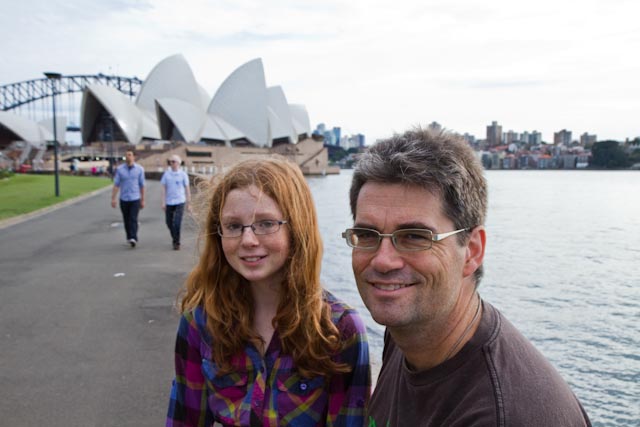
Arriving in the midst of a view that you’ve seen a million times is one of the things I love about travel. No matter how many times I’d seen it in postcards, movies or on TV climbing the Opera House steps and looking out at the Bridge was enough to take my breath away. Actually, it was enough to make me trip and slice open my toe. And after I sorted out that I hadn’t broken the camera while a kind local thrust Dora bandaids at me and whispered I was missing part of my toe and might need a doctor, I quickly got Maia to move in front of the bridge so I could get her picture. Just in case I had to spend the rest of our trip in the ER…

Happily I think I cut through my toe’s nerves—so once it was taped up I never really felt it and decided to skip stitches and save worrying about it for a more convenient time. We spent the next two days hobbling through the city—admiring the mix of old sandstone, modern glass, gorgeous green spaces and cool creatures.
 
Fun with cockatoos
 

Maia fell in love with the museums—or one museum in particular. We made two visits to the Powerhouse Museum, a museum which defies description and categorization but still managed to bring together the Wiggles and the International Space Station in a cohesive way.


Maia and Sirena fulfill a dream and drive the Big Red Car

The last two days of our visit were spent with our wonderful US/Mexico cruising friends from Orca in their home on a river that looked (and felt!) more like the Pacific North West than I could have imagined. Then it was back on a plane, back to Brizzie and back to dreaming about the ‘where next’ in our life.

May 22, 2013

Return Voyages


sunset on Moreton Bay
Somewhere in one of Paul Theroux’s books is a quote I meant to record, before I lost it (the book, and quote…). To paraphrase from faulty memory, he said that the feeling of leaving a place before you’re ready, before you’ve seen and done all you hoped to do, is what gives us the urge to travel: If we’re never quite satisfied, we’ll want to go back.


return trip to Springbrook National Park

We’ve spent the past few years caught between the drive to go back and the siren song of moving on. And when the world is so big, and so fascinating, who has time to visit the same place twice? No matter how compelling it is.

But over the past few months we’ve had a chance to savour the sweetness of visiting the same wondrous places more than once. The first time, when it’s shiny and novel, it seems like you memory only sketches an outline, it’s hard to see the detail.
 
Exploring Tangalooma on Moreton Island


But now that we’ve had repeat trips to Springbrook and out sailing on Moreton Bay I realize how much detail we must have missed along our journey. How many trails we never got to hike, how many view points stayed just out of reach.

There is a sweetness to seeing something new, but there is a richness in getting to see things again.