Showing posts with label culture. Show all posts

October 22, 2014

Road Triping with Elfis -- Exploring Alor


When we left Kupang we opted to sail off the beaten path—as much as there is a beaten path in Indonesia. A good percentage of the cruisers who travel through the country travel in one of the annual rallies and those who aren’t on a rally often follow the same routes. Sailing the world may sound very adventurous, but in some ways it’s really not that different than traveling around North America in an RV. Just like the journey of those land-based snowbirds, everyone on a boat follows the same seasons and tends to show up in the same harbours, hitting many of the same highlights.

Heading off the beaten path means picking a place that sounds interesting—then doing some research and discovering no one’s mentioned your destination in a cruising guide or blog. When you show up people tend to be surprised to see you and also not quite sure why you’re there.

just a few of the day's visitors
Being off the path also means you lose access to years of accumulated cruiser knowledge. Something I hadn’t realized we were so reliant on until I looked up our current port of Kalabahi. I was intrigued by the shape of the islands (it looked like there would be lots of calm anchorages and coral reefs). But the only info we found was a brief entry in the Lonely Planet guide, which oddly enough doesn’t tell you where the best anchorage is or where to bring your dinghy ashore (we anchored in the cove past the port and brought our dinghy to a breakwater in the inner harbour where a security guard tied it up for us).

What we did discover was Kalabahi is the access point for a great dive area, and while we were keen to check out the diving I also found a mention of a nearby traditional village called Tapkala. These two things were enough—we decided that even if we couldn’t find online reassurance that Kalabahi was a good destination, we’d check it out ourselves.

Maia is frequently asked to pose for pictures
Being the only white people in a remote Indonesian city is both overwhelming and charming—children ran after us practising their English while scooter drivers stared at us in such obvious shock we nearly caused accidents. The attention was almost enough to make us scurry home—but even on the boat we got frequent visitors.

Finding information about diving and the little village we wanted to see was more complicated than we expected. Not a tourist town, Kalabahi doesn’t have a handy tourist office to check in with. We thought stopping in at the hotel might be an option but as we were making a plan (maybe we’d just catch a bemo and say where we hoped to go and see what happened?) a car pulled up beside us and Elfis, (who didn’t speak English) and his friend Noby (who spoke even less) offered to help.

I wonder sometimes what we teach Maia when we climb into a strange car, with strangers who don’t speak English in a city we know nothing about. I hope she learns that we all have more in common than we think and the distance between us is less than you imagine. Also I hope it teachers her that most people are kind. But I also don’t really want HER climbing in strange cars with strangers anytime in her near future—so it’s a bit of a conundrum.

Somehow though everything about Elfis felt comfortable—from the stuffed animals on his dashboard, to the mellow (and very bad) Christian music on the stereo, to the extreme effort he made to hunt down someone who could tell us where Tapkala was.

Noby and Elfis
I’m pretty sure that without Elfis we would never have found Tapkala. It turned out to be located across the island and way up a mountainside, even if we’d found the bus that was supposed to go that way it would have been a seriously hot hoof up the hill. Instead we were chauffeured like visiting celebrities. Seriously. Little children would wave and call out to us as we passed…

Tapkala is best shared in pictures. The village is a subsistence one but the tourists that find their way bring in much needed cash. Sadly the women bring out the same Chinese ‘handicrafts’ that we’ve seen everywhere from Mexico to Fiji. But the headman was eager to show us around the village and teach us about some of their traditions—he dressed up in his (rather terrifying) warrior clothes and then explained what each barb of his bow and arrow was designed to kill us.


September 18, 2014

A Rocking Detour--Stanley Island Aboriginal Art


It began like so many of our adventures do; a casual mention over drinks and a few half-recalled details. “It’s cave art—there are supposed to be 19th century sailing ships, dugongs and turtles.”

When I persisted, we managed to narrow down the island; Stanley Island in the Flinders group and get a few directions, “go in through the mangroves until you find the trail.” Even the government website was a bit light on details, “This walk on Stanley Island begins at the Mangrove Landing in Owen Channel. The track crosses to the northern side of the island, continues along the beach and meanders through low woodland.”

Owen Channel, it turns out, is over two miles long. Fully half of Stanley Island has mangroves along this length. We anchored at one end and made our way down the channel by dinghy, bashing through big seas in high winds, completely soaking ourselves through, while playing eenie meenie with the mangrove landings (ahem, small croc-infested beaches…)

Mangrove Landing
Being a pessimist I suggested we start with the furthest beach, which after we crossed the fringing reef, turned out to be a long dinghy drag through shallow water (We’re in an area that tells us to bring up our dinghy at night because crocs are known to bite them.) Then we anchored the dingy and went exploring behind the mangroves and looked up a hill for signs of a trail. This is where we found the park signs telling us we had found Yindayin. (Not to complain—but if I were putting up a sign for a water access only park, I’d probably put it where you could see it from the water…)


From the sign we set off through a kapok orchard, if you’ve ever seen those old kapok lifejackets these are the orange-sized fruit where the fluff comes from; past meter-high termite mounds; and skirting the Castle Peak cliffs. We wound our way through huge middens with silver-faded shells; and past discoloured signs that told us about the island’s bush tucker, eaten green and fresh this was tasty, this cured tooth pain, this bore fruit.
kapok orchard and fruit
 
When we reached the beach on the other side Maia warned me that this better not be like the cave art we trudged up a desert cliff to see in the Sea of Cortez—there, the reward for our heat-stroke inducing hike were red handprints of a rather nebulous pedigree found in a cave full of bat guano.

After admiring a few shells we found the trail up from the beach and reached another aged sign, this one explaining that an elder from the Yiithuwarra people, and the last baby to be born on the site, had helped interpret the site. He also drew the last image to be created; a dugong, some 60+ years ago.


Following an overhanging cliff we reached ‘ships shelter’. Awe is a word that should be used sparingly. But as I took in the cliff face that curved around and over me—forming a wide cave with natural air conditioning—I was awe-stuck. Sailing ships: painted in red and outlined white overlapped each other and obscured other images. Some ships had the distinct sterns of 18th century European galleons; while others had the more exotic eastern curves of Macassan praus; still others brought to mind early 16th century Portuguese ships. Layered with the ships were other signs of daily life; an eagle ray, crocodiles, dugongs, turtles and symbols that were too surreal to discern. 
Then we signed the guest book--discovering we were about the 40th group of people to visit this year.


Following the cliff side further into the center of the island the cave deepened into what had been a living place for over 2900 years, right up until WW2. The people who had lived here experienced the tragedies we now know about; some of the men were inevitably lost in the beche-de-mer, pearl and trochus shell industries, the children were sent to missions, illness took a tremendous toll.

But before all of that, while the island still had everything the people needed to survive, someone captured the moment of contact and recorded strange ships as they sailed by.

February 14, 2013

The Cricket, more adventures Down Under

 
 'Why is it THE cricket?’ I asked, as a group of us sat around a table eating prawns, drinking wine and enjoying the dinner that came with our VIP cricket tickets. “Don’t you go to THE cinema? It’s just a definite article,” I was told. (Which made sense.) “Just like going to the tennis or the hockey.” (Mmm, not so much.)

The cricket is like that for me. It almost makes sense: You have a bowler trying to throw a ball at a wicket and a batter trying to hit the ball so it can’t hit the wicket. Good so far.

‘Wait! Are there are two batters running?!’ I was slowly putting it together: An over is six balls. We were at a 20 Over game which meant it would be over in about three hours (or four if you add in dinner and supper breaks) versus a test match which takes five days (six hours a day with tea breaks, and maybe naps). “Test matches,” I was told, “are wonderful. Like watching a waterfall.”


But while I had sorted out the overs and the innings, and took great delight every time a batter got a six (ooh!! Pretty fire explosions and loud music) it took me thirty minutes into my first ever match (thirty minutes!) for me to realize two batters were running at the same time.
Without Alex the game would have been nonsensical...
 It took me even longer to realize that when a batter hit the ball out of the ballpark (cricket pitch?) and into the stands (scoring a six—as in six runs. Fire!! Ooh, pretty.), the guy who caught it didn’t keep it, have it autographed and then later sell it on Gumtree—no, he gave it back. “They only get one ball,” my interpreter, the ever-cheerful eight-year old Alex, explained. Apparently even if the ball breaks they need to sift through a box of other used balls and find one there. A very economical sport this.

Fire, loud music and cricket dancers--what more could you want?
 ‘Hey! Why’d we get the fire?’ No one hit a six, but it turns out you also get fire, loud music and cricket dancers (sort of like cheerleaders who have no skills) when someone goes out. And someone can go out, or be dismissed, for one of five reasons (wikipedia says 10, but my interpreters were an eight year old and a co-worker of Ev’s who had an open bar at his disposal, so we’ll accept five).
Vip section meant fancy food and free booze, and a dress code...
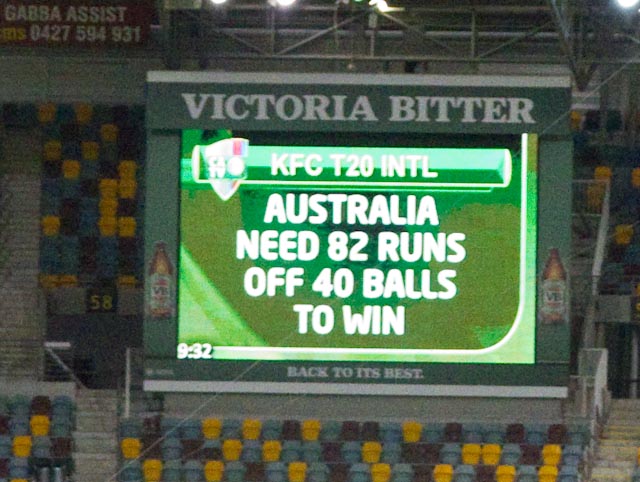
And so went the game. Until the near the end—when using relatively simple maths Evan and I realized there was no way for Australia to catch up. But all around us the crowd kept cheering and urging them on. So we asked about that. “Oh, sure they still have a chance!” We did the math—1.5 overs left = 9 balls or a maximum of 54 runs. Oz needed 51. “Oh, so not so good then… But they could get extras!”

‘Are extras common?’ I asked, as two more batters were dismissed and the West Indies win seemed sealed (as evidenced by one of the fielders doing yoga stretches). “No, not really,” I was told.


Can you see the trend?
 ‘By the way,’ I asked, ‘which countries make up the West Indies team?’ My question got a puzzled look. Not the cheerfully bemused look I got when I asked dumb game questions like ‘why do they keep switching sides?’ (They do it at the end of each over, or after some one is dismissed, unless it’s the last ball of the over—or something like that). The West Indies, I was told, are just that, “The country of West Indie.”
There is no country of ‘West Indie’, I said.
“Are you sure?” I was asked. By a few people.

November 6, 2012

The Melbourne Cup


Melbourne Cup spirit at Maia's school
 Ever wondered about the difference between on the wag, chucking a sickie, or being crook?
one of the live sites in downtown Brisbane
 

Probably not, considering most people don’t need three different phrases to describe the fact they’re not at work… Being crook means you’re actually sick, though many Australians push on and head to work whilst crook—not wanting to waste a perfectly good day off. Chucking a sickie means calling in sick, when you’re not. And being on the wag is what you do on Melbourne Cup day—it’s the moment you leave your desk to go to the washroom, change into a new dress and hat and sneak out the door—hoping your boss and co-workers never notice you left. Which in all likelihood they won’t—because they too are off changing their clothes and sneaking out doors.
watching the race
 The Melbourne Cup is a horse race—in its 152nd running, it’s also a nationwide excuse to start partying at 11am and collectively drop $150 million at betting stations that are conveniently found just about everywhere, including street corners. Maia was the only person in our family to lay a bet (ah, yes the Ozzie school system…) though her horse didn’t fare so well and placed twelfth. Her teacher did better in the staff betting pool—and came away with the prize money and a bottle of wine.
street corner betting station
 It’s called “The Race the Stops the Nation”. And it truly is. There were several live sites in the downtown area where the booze was flowing and people were dressed to the nines.

The race may just characterise Australia better than any other event. Skipping work to bet to excess on a sport many know little about (though this gambling excess fits in with the fact Australians are the world’s heaviest gamblers, by a hefty margin) and then drinking to excess—all without apology or a worry.

October 31, 2012

Halloween—the Aussie take…


 “That pumpkin is a special one for Halloween,” we were told after picking up the pumpkin from the pile labelled ‘Halloween Pumpkins’. “When you carve it you must be very careful. Pumpkins are hard and knives are sharp.”


The thing about being somewhere that is sort of like home, but not really, is it’s the differences that jump out at you. And Halloween in Australia is, well, different… Part of it is what little tradition there was that came over with Scottish and Irish settlers died out over the years—so the execution of Halloween is kind of like they’re trying to play a game they don’t know the rules to and have only seen on TV.

It’s not that Halloween is complicated—it’s pretty much as egalitarian as a celebration gets, as one Canadian reporter aptly put it, “Halloween has become the ultimate civic holiday. It brings us out of our houses to mingle with neighbours. It shows how we cherish our children. It gathers people of all backgrounds together. Halloween has no religion, no ethnicity. It is the festival that fits our modern, multicultural society best.”

One of the American mums at Maia's school has an annual Halloween party which has grown and grown
 At home Halloween has morphed into a celebration that has roots in the harvest festival of Samhain and the Christian holy days of Hallowmas; and the costumes, decorations and traditions range from fanciful to frightening. Sure the candy is fun—but trick-or-treating is really about letting your imagination go wild as you plan and dress up in your costume, then enjoy all the reactions of friends and neighbours.

The first clue that things were different here was when Maia asked kids in her class what they were going to be for Halloween and none of them really understood the question. The dress code here is witch or ghoul. No one was spending weeks planning a costume and no one’s grandpa was going to end up having to assemble a complicated tractor costume from scratch.

The common complaints about Halloween in Australia are it teaches kids to beg and it’s just a bunch of consumerist hype. And I can see how it can look that way. But as a bang for your buck memory-maker I think Halloween might be as affordable as it gets. And I think the community building that comes with meeting all your neighbours kind of balances out the candy consumption…


Despite the differences; the streets were comparatively empty and the limited houses that participated only sported a discreet balloon or at most they had a pumpkin on the stoop giving it an air of a scavenger hunt rather than the trick-or-treating we’re used to--the kids still had a blast. There’s something quite magical about making your way past familiar but darkened landmarks and getting to knock on a neighbour’s door for no reason at all other than to say, “trick-or-treat!”

January 27, 2012

Gung Haggis Fat Australia Day


The cockroach that won the race was accused of being on steroids: An accusation that didn’t seem to go against any of the event’s rules. Flying is a no-no (and as anyone who lives on a boat can tell you, these buggers can really get some air) but steroids, apparently, are cool.
pipers piping in the roaches
random Aussie teaching us the rules
  After two cockroach races, a go at dunking a random Aussie in the dunk tank, and leaving a few dollars at the bar it was time to head back to Totem and continue with our day’s events. For Australians—it was Australia Day. But for our wandering band of nomads it was Gung Haggis Fat Australia Day—a combination of Australia Day, the Chinese Lunar New Year and Robbie Burns Day (Lord Selkirk entertained Robbie Burns at his mansion back in the day and when Burns was asked to say grace before a meal, he composed the Selkirk Grace, which is recited to this day at Burns suppers. This, for us, has always been reason enough to celebrate. Well that and Scotch.)


So the kids decorated, and Behan and I cooked, and Jamie and Evan kept our glasses filled. And our makeshift holiday of poetry reading, fortune cookies and steroid-pumped cockroaches began to feel like something meaningful and real. Instead of Haggis we had Kanga Bangers. And rather than a Tipsy Laird for dessert (trifle) we opted for Pavlova. And we made plans to celebrate again next year—yes, next year. Evan has accepted a job and it seems Australia will be home for a while.

Jamie and Emanuelle from Merlin
 As we dinghied home from Totem--rounding Kangaroo point and then watching the necklace of lights on the Story Bridge give way to the cityscape--I realized this will be the forth country the three of us have lived in.

I’m not sure when you make the transition from visitor to living in a place—especially in a foreign country, where every time you feel like you start to understand it, something weird happens—like cockroach races. But as we made our way up the river toward our boat, the realization that I live here sort of snuck up on me. 

I’m coming to see the idea of home as a mosaic—a montage of inspiration, and people you love, and celebrations you adopt that goes beyond place. It’s the life you create when the sum of its parts are greater than the place you are. Home is also everything you bring with you and all you’ve ever been—except cockroaches.

Happy Gung Haggis Fat Australia Day.