Showing posts with label maintenance. Show all posts

November 7, 2014

Lightning Protection Aboard


We're sailing into rainy season--which means thunder and lightning

Do you diligently put your portable electronics in your oven or microwave oven during a thunderstorm?  You might be fooling yourself about the lightning protection you have.  Here’s a reasonable test – put a mobile phone in the oven and dial it from another phone.  Do you hear ringing?  If so, radio frequencies are penetrating the box and your oven is NOT an effective Faraday Cage (FC).  We were happily putting our electronics in the oven until I had a ‘oh duh’ moment – the oven has a glass door.  This is a big hole that prevents it acting as an effective FC.  Lightning acts on a variety of frequencies, but much of the high energy radiation is the high frequency radio spectrum (which means short wavelengths – more about this shortly)

A Faraday Cage is named after Michael Faraday, the famous British scientist. He found that an empty metal container will only allow external electrical charges on the surface of the container.  Properly done, they shield the interior from external electromagnetic radiation if the surface is thick enough, and any holes are significantly smaller than the wavelength of the radiation.  Microwave ovens are allowed to leak some amounts of radiation, so depending on the particular oven, they might not be as good as you hope to protect against lightning.  Normal ovens, with their large gaps (or glass doors) are likely very poor FC.  

Construction details:

Start with a metal box, big enough for all your portable electronics.  This might be larger than you think because the modern cruising sailboat is laden with electronics that should go in the box when lightning threatens.  We bought an aluminum tool box and modified it.  Other suitable boxes could be army surplus steel ammunition boxes (though may be hard to explain to customs when they search your boat), cookie tins with tight fitting lids, galvanized garbage pails with lids, etc.  It has to be metal (no, it doesn’t have to be iron or steel, just conductive). 

Seal up all the small holes – this is harder to do than you might think.  We cut off some front facing latches because they prevented our box from fitting into a particular tight spot. We taped over the resulting holes with mylar foil tape, inside and out.  You have to really pay attention to very small gaps for best performance.
conductive foam gasket

The lid was not a tight fit, just a typical shoebox type toolbox construction.  So we fitted a conductive foam gasket to the top of the box.  This is not something you can buy at your local hardware store (check online electronics stores like digi-key.com or mouser.com) – it’s a compressible foam gasket with a very fine metal mesh cover (nickel plated copper in our case) that provides a tight seal that our box lacked.  We added some overcenter clamps to hold the lid down firmly onto the gasket.  These gaskets are specifically designed for FC’s to protect sensitive electronics.


Finally we lined the box with some corrugated plastic sheeting to prevent the electronics from touching the walls of the box – this might be not necessary, but the electrical charge on the outside of the box can travel through the walls of the box.

Do you need to ground your FC?  Nope, not really.  A FC will work if it is grounded or not.  However lightning is attracted to large metallic objects and it is a good idea to ground your box if your regular lightning grounding system conductors (cables from mast or chainplates) pass relatively close to the box to prevent side-flashes.

What lives in our box:

  • 2 laptop computers
  • 3 spare autopilots
  • 240V battery charger (because we are seldom at a dock we use a portable battery charger for our batteries)
  • Spare VHF
  • Spare fishfinder
  • Handheld VHF
  • 4 ebooks
  • Spare GPS
  • 4 x portable hard drives
  • 2 laptops
  • Desktop mini computer
  • 2 phones
  • iPod
  • 2 DSLR cameras
  • About 5 lenses
  • Camera flash
  • Several point and shoot cameras
  • Chargers for cameras
  • Video camera
  • Label maker
  • Pactor Modem

What doesn’t fit:

  • Radar
  • SSB/ham radio
  • Big LCD computer monitor
  • Hard wired autopilot
  • VHF
  • Depthsounder

What about stuff that is hard wired or is too big to go in the box?  Unplug as many antennas, power cables, etc. and hope for the best.  It’s all you can do.

Disclaimer: Evan is a lowly mechanical engineer, not an electrical engineer, so all this advice is at your own risk.

June 10, 2014

More Maintenance - Exhaust Elbows

Our engine is a Yanmar 3GM30F. The exhaust mixing elbow is a known wear item. It carbons up, and rusts out from the inside. While carbon can be scraped out, the internal rusting can't be fixed. It should be replaced regularly - especially if you are heading out for areas of the world where parts are harder to get.  Our engine is about 15 years old. The previous owner put about 550 hours on it over 10 years, and we now have a total of 2200 hours on the engine.  In diesel terms, it's fairly young - and I wouldn't be surprised if the exhaust mixing elbow is original.  I'm slowly learning that preventative maintenance is easier than fixing things in exotic locations.

Recently the engine's exhaust has been smoking and the engine has showing some signs of overheating.

Have a look at the exhaust passage of the old elbow and compare it with the size of passage shown in the new mixing elbow.  Note the old elbow opening is probably 1/3 the area of the new one.  Poor engine couldn't breathe...


June 9, 2014

Maintenance Thoughts

Hose clamps are evil. They are trying to sink your boat or dash it on the rocks. Don't believe me?

Exhibit #1:
 See that hose clamp on the bottom of the hull, about halfway between my foot and the shaft seal? It's a broken hose clamp. Its purpose is to stop the shaft seal collar from sliding forward, if it's set screws ever loosen off. Which they do - on our maiden voyage with the new engine we had a minor sinking emergency when that very thing happened.

So the hose clamp is just a backup in case the set screws fail. But it has fractured, no doubt due to very small amounts of salt water mist that the shaft seal lets through. A new one is in place, just to the left of the shaft collar.

Exhibit #2
 The hose clamp on the left is the one from the picture above. The one on the right is from the engine's fuel line. I was changing out our electric fuel pump (useful for priming the system after you change the fuel filter or in case the diesel lift pump fails). It came apart in my hand.  It looked fine. Had it failed in use, the engine would have stopped running due to air in the fuel line.


A tale of two masthead lights. Masthead lights (aka steaming lights) don't sit on the masthead, they are located on the front of your mast and indicate you are under power. Stupid name but that's the COLREGS for you.


 This is a Perko light. It is heavy, made of cast zinc and the design has not changed in at least 30 years. It is stupid. How do you change the bulb, dangling 20 or 40' in the air on the front of the mast?

1.  Remove the two machine screws holding the fixture to the mast


2. Flip over and remove four teeny tiny screws on the back.

3. The front lens then comes apart, into three loose pieces.  Which you have to hold into place after removing the bulb and screw back into place.

4. In doing so, you yank the semi-corroded wires from their nuts.  No problem, just loosen the nuts and re-attach the wires.  However the nut also holds the bulb holder inside the fixture. So when you loosen the nut, the bulb falls inside the fixture.  Go back to step 3.  Design like this has no place on our boat. So I yanked the evil thing off and replaced it with this:


The new light is a new Aquasignal.  It has 1 screw to remove the lens and get at the bulb. Older versions had two.  Somebody at Aquasignal knows lights.

July 4, 2013

The Hard Life-Australia


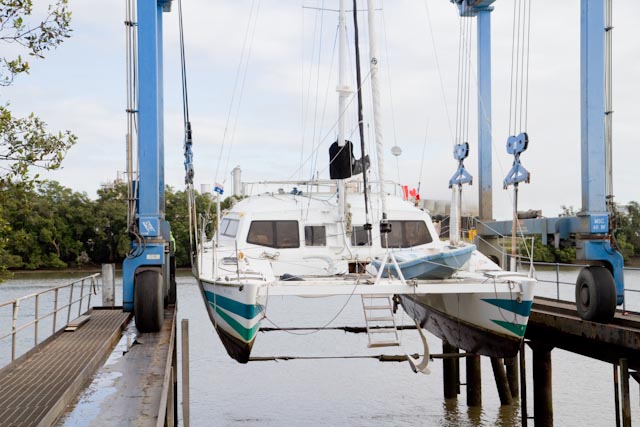
Hauling out is difficult, time consuming and expensive (and occasionally dramatic). So we tend to put it off. In fact, the last time we hauled the boat up onto dry land to paint the bottom was May 2010 (we had such a terrible paint job done at Abaroa’s we ended up careening the boat in September 2010 and adding another coat of paint). This time we were hoping to eek every last bit of use out of our paint, which we did, plus a year or so. About a month ago when scraped a barnacle farm off the boat we knew it was past time.
 
we just fit
Anyone with a cat can tell you finding a place to haul takes a bit of research. Because of our width we tend to need travel lifts designed for really big boats—which leads to a really big price. Our strategy is to hunt out smaller-extra wide lifts in industrial boat-yards, which means we end up in interesting places. But the price tends to be slightly more manageable.
 
barnacles, weed and river goo
This time we ended up in Brisbane Marine Industry Park on the little lift—which Ev had carefully measured and saw we *just* fit on. Though it was a narrow slot, and the current was on our beam, getting into the lift was drama free (yay!). Once the boat was out (Maia: “Oh, I love the smell of a boatyard!”) and we looked over the hull (Evan to yard worker: “It’s not so bad, is it?” Yard worker with bemused look: “It’s filthy.”) we were moved to our spot and the work started. And so did the rain.


looking at the bend in the rudder--this one is slated for replacement shortly

Winter in Brisbane is dry season. You can ask locals and many will tell you about years that went by without measurable rain in June or July. This year though: record breaking. It’s been raining so much it seems to have thrown the weather forecasters off their game. The weekend, which was supposed to include an occasional shower, turned into one big rain fest. We ended up draping the boat with everything tarp-like we own (including the tent) in an effort to keep the hulls dry enough to paint.

Then we ran into another problem. North American power tools don’t run on the Aussie 240 outlets and when it rains non-stop there isn’t much sun available to charge solar panels. A quick trip (with a borrowed car) to the hardware store for a battery charger (and more tarps) solved the problem though.


Once we were set up it was time to start sanding. Problem #3 was the discovery that 18 months in brackish water had lead to the development of some osmotic blistering. We had the same thing happen on little Ceilydh after her time in the Rio Dulce—not sure of the science behind it but the blisters were pencil eraser to dime sized and none went into the glass. We treated them by popping them open, rinsing them well, and then any that need filler after sanding were filled.
a few of the little blisters we found after they were opened and dried...
Next came a couple of coats of paint, a few minor repairs and after four days it was back into the water on a bright sunny winter day and out on the bay for a short sailing holiday.

The paint is supposed to be 30 month paint—which I’m sure we can stretch….

April 26, 2013

Regalvanizing-from A to Zinc


rusty chain--some links are in better shape than others
If you’re not a boater, a rusty anchor chain probably isn’t that exciting a thing to contemplate. But when those rusty links are the link between your boat and your anchor (a piece of equipment that is easily one of the most important items on a boat, or under a boat) the rust gets personal.

Chain is expensive stuff—and in recent years, because of increased costs, the protective zinc coating found on chain has become thinner. This means that unless you are diligent about washing down your chain, end for end it as it shows wear, and touch it up with a wire brush and zinc paint when the first spots of rust do show up, before you know it you’ll have a rusty ball of chain in your anchor locker.
 
take your chain for a drive
Or at least we did. Our chain is about 5 years old. Not that old in the boating world—but a few years of constant use, followed by a year in the anchor locker meant that our chain was rapidly approaching the cut-off point between salvageable and garbage. Although surface rust, even if it’s a bit flakey, isn’t the end of the world for chain-but you do need to remove heavy rust to have chain regalvanized.

As a guideline you should toss rusty chain if:
- Wear exceeds 10% of a link diameter (check where the links connect).
- The chain is cut, nicked, cracked, gouged, or pitted.
- It’s distorted, twisted, bent or stretched.
- You don’t know its history, including how many times it’s been regalvanized.

If you got around to regalvanizing before we did and the surface rust was fairly light (indicating you still have some zinc coating left) you can probably send it straight for regalvanizing without prep. If you have more rust then you’ll need to look at sandblasting, which is normally hugely expensive, unless you try a version of poor mans sand blasting.
 
bare metal after 10 km--we were still able to see the stamps on the links indicating we hadn't lost much material
We headed off out of Brisbane in search of a sandy road. When we found one we tied the chain the trailer hitch and set off down the empty road (the one car that passed us was pretty confused, or thought we were confused). By end-for-ending the chain a couple of times and driving through sweeping S turns the chain started to show bright metal after about 10k. Then it was off for galvanizing.

Because I ask about this stuff I learned the first step of the galvanizing process is a caustic soda solution to remove grease and oils from the steel. The chain is then immersed into a pickling solution of sulfuric acid. Then it’s ready for the molten zinc.


newly galvanized chain

The result is a thicker coating of zinc than what the chain had when it was manufactured—which means it should last longer. Especially because we’ll take better care of it this time round and not wait so long before regalvanizing it again.

Our cost at Industrial Galvanizers in Brisbane was $2.05 a kilo—and our chain came in at $166. Far less than new chain would have cost (we can’t get our chain here so would have needed a new gypsy as well).

January 19, 2011

Cruiser Maintenance

in Bucerais looking toward the anchorage
 The days are flying past in La Cruz. Ev’s parents were here for a week and we had a great time showing them the sights. Now we’re midway through a busy week of chores, errands and appointments.

Yesterday though I took the day off for a lusciously indulgent spa day at The Marriott CasaMagna with Monica from Savannah. There was something wonderful about spending the day in girlfriend mode—something most women out here really miss. The Blue Agave scrubs, followed by the hot stone massages, were really just the icing on the girl-day cake.

Cruising is about being a tight little family unit that stays together, plays together and endures the odd storm together. While we do meet wonderful people along the way—those enduring friendships that most women rely on can be hard to maintain.

The result tends to be a lot of women get a bit unhappy. It tends to be this creeping malaise that no one can quite identify, but it has something to do with living with guys who just don’t get what we’re looking for when we gossip about a neighbour or complain a bit about a discomfort. With a girlfriend we commiserate and exchange stories. Guys, being the more pragmatic type, either try to solve the problem or tell us to suck it up.

Neither response really works for me, so I tend to save up all my little bitchy thoughts until they become big bitchy thoughts and then I yell at Evan. A little girlfriend time tends to circumvent that whole cycle and we all end up much happier.

We recently met a couple who had also cruised before and who learned this lesson early on. He told us about how on their first cruise, which was something of an endurance voyage, she hated every moment, despite loving sailing. Midway through (when she was about to go home) they were given some advice: no matter what your budget, make room for the types of indulgences each of you needs, whatever they are.

For the guys this might be the right toy or tool, but for the women it might be a trip home to see family or old girlfriends. Or it might be slowing down enough that you can hang with a boat you click with. Or it could be a relaxing a week in a marina or a night in a nice hotel. Or maybe it’s a spa day with a girlfriend.

When we’re all on tight budgets being indulgent seems, well, indulgent. But the couple who told us about their cruise-saving strategy explained they were on the brink of divorce when they realized what she needed. They told us that the cost of quitting a trip and selling a boat is far expensive more finding a way to recharge your cruising batteries.

Obviously cruising won’t be for everyone. And some people will get out here and hate it, but sometimes all it takes to make it fun again is to find out what’s missing and add it back in. We think of it as maintenance—we work hard to maintain our systems, and the same needs to be done with our happiness…

December 2, 2010

Go Ahead, Drink the Water


this was covered by flooring and we knew the area was squishy, but the amount of rot was impressive...
I’m not sure how many entries we have about our %!#&! water tanks… The saga started on our first sail after leaving the dock in July 2009. After a boisterous passage across Georgia Straight, we discovered water on the floor of the starboard hull. Initially we decided it was just a leaking hose, but as the months went on we realized that our integral tanks were rotting away.

So in May Evan ripped out the starboard tank and rebuilt it. The plan was to do the port tank as soon as the starboard one was watertight. But that happy day never came. Every time we tested the tank water would spurt, burble, or trickle out of some miniscule breach in Evan’s glass work.

So the port tank—which was rotting under our feet—remained our primary tank, despite the fact we had to filter out splinters after a particularly bumpy wind event…

After making four attempts to find and patch leaks in the starboard tank—Evan became serious about replacing the portside built-in tank with a polyethylene tank. He found a company called Ronco plastics that seems to make tanks in every conceivable shape (except, of course one that would fit in the same place that the built in tank was located…)
our new 44 gallon tank
 But we found a spot (outboard, where his tool boxes had been), ordered the tank and had it shipped to Arizona. We brought it home and got it installed, and then turned the floor tank into storage. Then he did one final fix on the starboard tank—which seemed to take.
Evan built a new plywood/epoxy floor to cover the storage area...
 So…
That project just might be done!

November 12, 2010

Give Your Sails Some Lovin'

sail repair in paradise--who wants to swim when they can get all sweaty while wrestling with dacron?
 We’ve heard the story at least a dozen times while out cruising: someone hoists a sail, it fills nicely, then the next thing they know there’s a big pop, a ripping sound, and a whole lot of swearing.

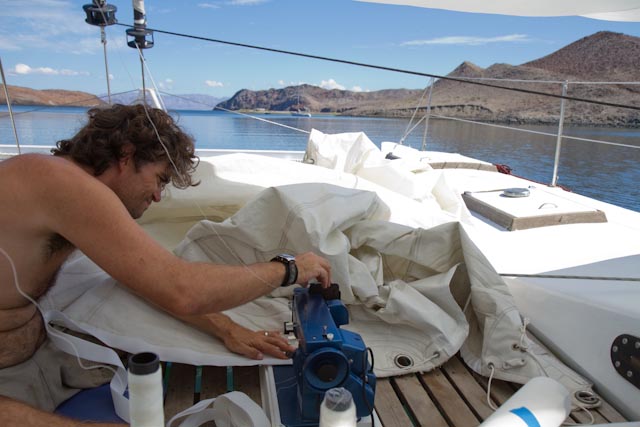
Fortunately for us, we met Jamie from Totem before experiencing this unhappy event for ourselves. When we were all in La Cruz he took a long look at our mainsail and informed us that without a few basic repairs we’d be flying scraps of fabric within the year. You should listen when someone gives you advice like that… So a few hours later, a period which included a lot of swearing at the sewing machine, the main was fixed back up and good to go for the summer.

Thanks to Jamie though we now have a routine. EVERY time we hoist the sail we look it over carefully—concentrating on the high stress areas. If we see something untoward (like we did while in Bay of LA)—a tear, broken stitching at a batten pocket, excessive fraying—the sail comes down and the cursed machine comes out.
washing (and drying) a spinnaker takes space
 The next step in our routine is to take advantage of water when we’re at docks and wash the sails. The build-up of salt and dirt accelerates the speed that sails wear out at. And because the things are freaking expensive—we’d like ours to last.

Washing also gives us a chance to inspect the sails up close and personal—something we try to do at least twice a year. And it makes you sort of noticable. So now everyone in the marina at Guaymas knows I'm real.

November 11, 2010

Well, Crap

 In the cruising life, there are a few things you don’t want to hear your kid say. While, ‘I shot Timmy with the spear gun,’ would be the worst, it only barely outranks, ‘I can’t make the toilet flush’ in terms of crisis status. Even then it might be a toss up, given in some places hospital care is usually easier (and cheaper) to obtain than boat parts.

Our head (marine talk for toilet) is pretty much the cheapest, simplest version on the market. It’s easy to service and comes with its own handy rebuild kit. It’s also been virtually problem free for the entire time we’ve owned the boat (although there was that holding tank issue). But considering this is the week for plumbing setbacks (I’m talking about the brand-new leaking water tank that I’m ignoring) it wasn’t too surprising when Maia informed us that our toilet had also packed it in.

Marine heads are, by reputation, shitty pieces of crap. And pretty much every boat owner has at least one story about an exploding holding tank or seriously backed up hose that led to a gag worthy incident (followed by a long hot shower with bleach). Everyone has a recipe for maintaining smooth and regular function (when talking about toilets folks, bad jokes are mandatory)—but even with liberal doses of vinegar and oil things can still go to hell.

Ours didn’t really go to hell though until after Evan finished the repair. Just as he was tightening the final screw that holds the pump together he heard a suspicious crack--the result of a screw fitting breaking off inside the pump housing. Now the thing leaks, and we need a new pump—a relatively easy to replace item that is found in any West Marine, but not, it seems, locally.

When Evan asked about ordering one he was told it would take two, maybe three, maybe more weeks. That’s a long time to hold it for.

Many modern boats have two heads—something that often struck me as redundant, especially because I can only think of a very small number of people who actually use their second one. Most have transformed the space into a closet, or pantry, or in one case, an office. The benefit I’m now realizing is in the redundancy. We had just about every spare part you might want for a head, except for the pump housing itself. Carrying an entire housing just seemed excessive—but if we carried around an entire spare head? Problem solved...

November 10, 2010

Have Water, Will Wash aka I have deadlines, I'm not dead

 
  Evan and Maia pulled the boat into the Guaymas marina the day before they joined me in Tucson. We’ve been back for a few days, but we haven’t gotten around to pulling back out yet. For one, it’s cheap--at around $15 a day it’s not too huge a splurge. We’re also really taking advantage of the convenience of dock life to get stuff done.

Well, mostly Evan’s doing that. I’m so snowed under by deadlines that I’ve barely left my desk. And because I’ve been so scarce, for the second time while out cruising I’ve run into someone who thought I was a figment of Evan and Maia’s imagination—and didn’t actually exist. That’s a weird conversation to have with someone by the way…
 Anyway—we’ve acquired a lot of crap this year. I really don’t know where it came from, but we (meaning Evan) have been making our way through each locker and offloading stuff. Then he (yup, I'll admit it, I’m totally not involved) wipes down each locker and carefully repacks it with way less stuff.

Partly I think what happened is when we moved aboard our good intentions gave up on about day three of unpacking. Catamarans have big storage areas, and after a while it’s just easier to stuff them full of bits and pieces rather than making yet another decision about the value of yet another piece of rope, or which of the selection of kid’s lifejackets we own, we should keep…
 When we’re not (meaning Evan) cleaning lockers, we’re painting (I point out the flaws). We’re also installing a new water tank. After making five (and counting) attempts at making the newly rebuilt integral tank on the starboard side watertight, we decided to go with a fabricated plastic tank on the port side.

Evan assured me this would be a much simpler solution. So we’ll (meaning me) just ignore the fact the new tank is currently sitting on the dock leaking…

October 14, 2010

Aground in a Desert

This is a bit out of order--but I haven't been able to load pictures for a bit and this post needed pictures...


There is something endlessly cool about being able to drive our boat up onto a beach. It’s such a fun feature that rather than just putting up with the lousy bottom job we got in La Paz, we decided to remedy it.
 Puerto Don Juan has a beach which is simply known as the careening beach. The name goes back to the earliest guide book I’ve found on the area, so my guess the beach, and its use, is a historical one.
 These days it’s pretty much only the catamarans that careen. But back in the days before travel lifts monohulls used to do the same, painting one side of the hull on one tide and the other side on the next. (We do much the same—except it’s one hull per tide)
 The concern with careening right on the beach is an environmental one. Despite our best efforts it’s hard to ensure nothing toxic makes it into the sand.
 But the fun—of walking around your boat and seeing it from every angle, almost makes up for the effort. And if that doesn’t make you feel good, the lack of a $1000 haul out bill definitely does.

August 22, 2010

If it Ain’t Broke…


Paint it.

An average cruising boat (at least in the circles we hang out in) has a to-do list that runs into pages. There are those occasional people who somehow put together a cruise-ready boat, and then pay someone else to maintain it. But for the rest of us, life revolves around repairing stuff when it breaks, fixing stuff so it won’t break, or installing new stuff after something breaks. 
In roughly that order.

 There are times though when nothing is actively broken, needing installed, or needing beefing up. When this happens, we move out of survival mode and into beautifying the boat. Actually, most of the time we go read a book, but this is why after living aboard for over a year the boat’s interior still needs painting.

When we first bought this boat six years ago, Evan told me it would take a year (or so) to build the cabin and get Ceilydh cruise ready, and then another few months to get her looking cosmetically good. The only stipulation I made was that I didn’t want to cruise on a half-finished boat. The boat ended up taking five years to get cruise ready and while it was more than half-finished when we finally left, it wasn’t finished, finished.
needs two more coats, then we'll do the white areas and the varnish...
 The parts of this boat that aren’t between 1-4 years old, are 23 years old. And I’m pretty sure the last time the wooden trim saw a lick of paint or varnish was roughly 23 years ago. I don’t know if it’s a man-woman thing, or a blind-not blind thing, but the all that old peeling varnish and battered paint makes me a bit crazy. Evan insists it’s not that noticeable and after all what’s more important to me, two functioning water tanks, or fresh paint. I kind of think it shouldn’t be an either, or situation. I should get to have a pretty boat and clean drinking water…

Although the water tanks are still a work in progress (we had a leak when we recently tested the first tank Ev rebuilt) but painting seems to be a job that is better suited to a hot Baja summer. So before we left La Paz we stocked up on paint, tape, and sand paper. The plan for the summer is that between more pressing repairs, we’ll paint. And varnish. And paint some more.

Today’s task is the galley. Goodbye, ugly, old water-stained wood. Hello, whatever colour the paint guy made us.

May 7, 2010

The Hard Life


 I realized this morning that the last time I lived on the hard on a boat was when Maia was 13 months old. Back then, going up and down a ladder with a toddler, who wanted to do it, “all by myself”, added a special element of terror to the experience. The time before that, I was seven months pregnant, and that wasn’t much fun either.

It’s still not fun.

Boats aren’t meant to sit up in the air. And no matter how much they might need that annual maintenance (which this time was put off for nearly three years…) the hard life, is, well, hard. Not only are you living life on a bit of a tilt, and going up and down a ladder and across a boat yard every time you need access to things that flush, but boat yards are not clean places—they’re actually quite filthy. And the people who spend time in boat yards are really not the kind of people you want influencing impressionable eight-year olds—there were more Spanish swear words flying around yesterday than I knew existed...

The reason for the swearing was our haul out on the marine railway probably didn’t go as planned. In fact, I’m almost certain the fact that the boat lost steering immediately after picking the crew who were securing us to the rail car caused some concern. I know I yelled.

The problem is Mexican hand signals. I’m not sure if you’re familiar, but they can be confusing. Come here, can look an awful lot like ‘get the hell out of here, death is imminent’. Even the signal to cross the road seems a bit ambivalent, it sort of looks like ‘sure, go, maybe, or not.’

So when we headed into the marine railway, there were several groups of workers who seemed to wave us away, then wave us back, then wave us one way and then the other. Meanwhile as we tried to sort out what we needed to do Evan spun and reversed, and spun the boat some more--all while in a narrow, current filled channel. Finally we realized we needed to pick up some of the boatyard workers before driving into the railway car. The pickup worked okay initially, and then it didn’t. With no warning, our engine went wonky and the boat stopped spinning and reversing on command and the next thing I knew the crew were jumping overboard.

Happily rather than swimming off in fear from our boat with no steering, they had a go at manoeuvring us into the railway car: pushing us in sideways and backward, while swimming. Amazingly the technique worked. And we’re here. And Evan has a small fix to make on the motor.